· Rehman Ahmad · 7 min read
Division Worksheets: Target Wheels with Answer Keys (Free Printable)
Free printable division worksheets with answer keys: target wheels for divisors 2 to 12, shuffled dividends, and a mixed challenge wheel — the natural next step after times tables, from a head teacher's classroom.

Division Worksheets: Target Wheels with Answer Keys (Free Printable)
Every year I watch the same thing happen. A child rattles off the seven times table without a pause — then I write 56 ÷ 7 on the board, and the same child freezes. The table is in there somewhere, but division asks for it backwards, and backwards feels like a different subject.
That freeze is exactly why I built these division worksheets. Division is where times tables pay off: every division fact is a multiplication fact read in reverse. A child who truly owns the tables already owns most of division — they just need practice walking the road in the other direction, until it stops feeling strange.
Download the pack
The full set is free, printable, and comes with complete answer keys:
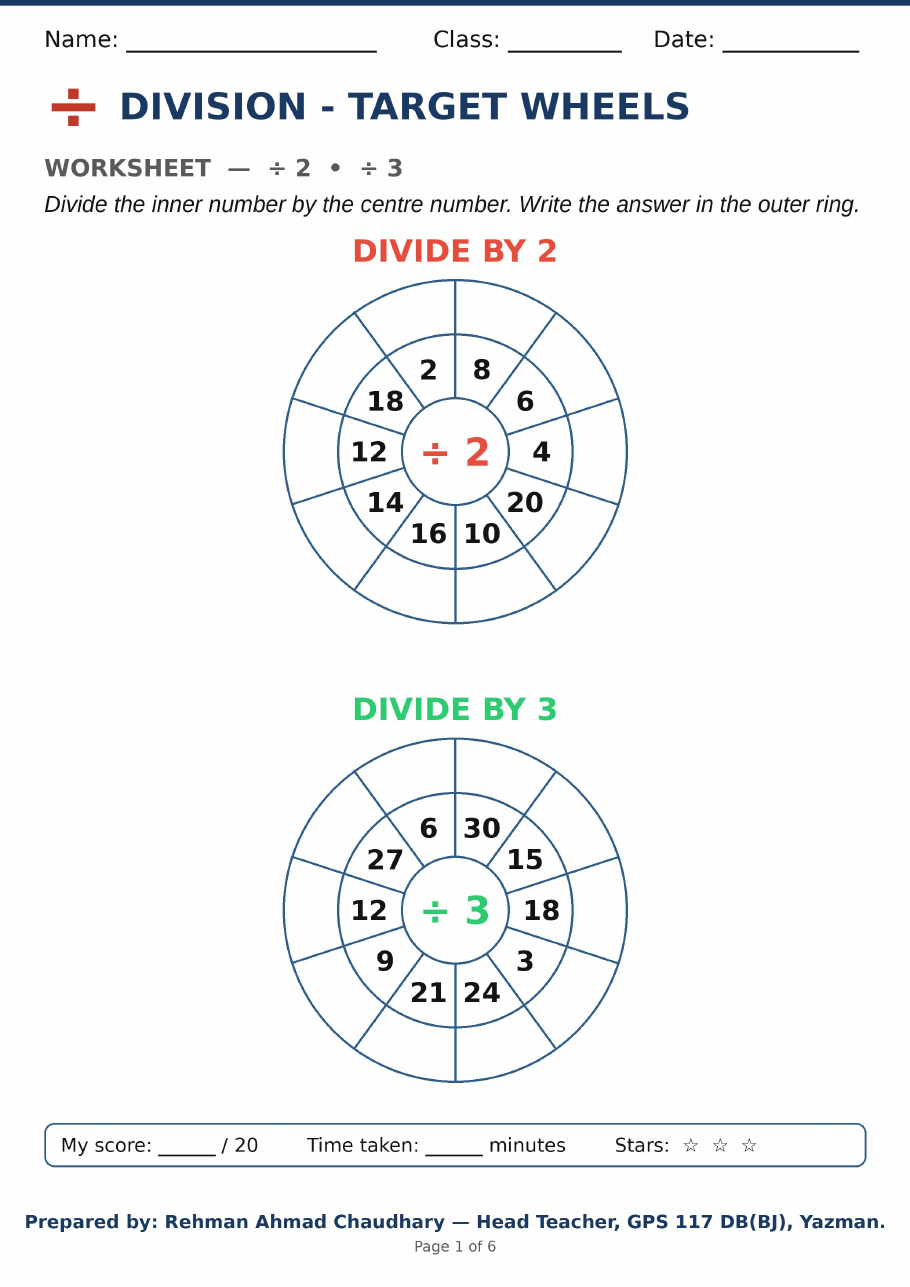
Inside you will find one wheel for every divisor from 2 to 12, a mixed challenge wheel where every slice changes the divisor, and a matching answer-key file so children can check their own work. Twenty questions per page, 120 questions in total.
Why wheels work for division
These division wheels are the mirror image of the multiplication target circles my classes already know. On the multiplication wheels, the table number sits in the centre and answers grow outwards. Here the pattern flips: the divisor sits in the centre — ÷ 4, say — the inner ring holds the dividends, and the child writes each quotient in the outer ring.
That familiarity matters more than it sounds. Children are not learning a new worksheet format and a new skill at the same time; the format is an old friend, so all their attention goes on the division itself. And because every wheel quietly repeats the same message — this number came from that table — the inverse relationship between multiplication and division stops being a sentence in a textbook and becomes something they have done 120 times.
If a child’s tables are still shaky, wheels for division will frustrate more than they teach. Start with the times table target circles worksheets first — same format, multiplication direction — and come back here once the tables are firm. Division built on weak tables is a house on sand.
A worked example
Take the ÷ 4 wheel. One of its inner slices shows 36. The child thinks: four times what makes 36? Four nines are 36 — so 36 ÷ 4 = 9, and 9 goes in the outer ring, in that same slice.
That is the whole method, and it is worth saying out loud to the class: division answers are hiding inside the tables you already know. Every slice of every wheel is solved the same way — centre number first, then ask which table fact produces the inner number.
How I use these in class
Printed practice. I print one page per child — two wheels, twenty questions — as the main practice after teaching a new divisor. The wheels mix the dividends out of counting order, so children cannot chant their way down a sequence; each slice has to be thought about on its own.
Oral race in pairs. Two children, one wheel, no pencils. One points at a slice, the other says the quotient aloud; swap roles every slice. First pair to finish the wheel correctly wins. This takes five minutes and produces more division practice — and more noise — than twenty silent minutes.
Homework. One wheel a night is enough. Because the answer keys exist, I ask parents or older siblings to check the sheet at home, and I only re-mark the ones a child flagged as hard. That keeps homework honest without eating my evening.
Self-checking with the answer keys. This is the habit I value most. After finishing a page, children mark their own work from the key, in a different colour, and write their score in the strip at the bottom. A child who finds their own mistake learns twice; a child whose work I mark learns once, later, when they may not even look.
Tips that make division stick
Chant the table backwards. If a class knows “seven eights are fifty-six” only in the forward direction, division will always feel like translation. We practise saying it both ways: 7 × 8 = 56, so 56 ÷ 7 = 8 and 56 ÷ 8 = 7. Two minutes a day, out loud, as a class.
Start with ÷ 2, ÷ 5 and ÷ 10. These divisors lean on things children already feel confident about — halving, counting in fives, and place value. Early wins with the friendly divisors buy the patience children need for ÷ 7 and ÷ 8 later.
Watch for the classic slip-ups. The commonest one in my classroom: a child writes the divisor as the answer — 36 ÷ 4 answered as 4, because 4 is the number their eyes keep landing on. The wheel format helps here, because the centre number is visually separate from the answer ring. Another frequent slip is answering with the table partner instead of the quotient, writing 36 ÷ 4 = 9’s neighbour. Slow, checked practice on the early wheels clears most of this.
Little and often beats one long drill. One wheel a day for two weeks fixes division facts more firmly than a single exhausting afternoon. The pack is paginated so you can print exactly that rhythm.
Who these worksheets are for
This is division practice for grade 3 upwards — roughly ages 8 to 11. Grade 3 children usually start with ÷ 2, ÷ 5 and ÷ 10 and add divisors as their tables grow; grades 4 and 5 can take the full set including ÷ 11 and ÷ 12, and use the mixed challenge wheel as a timed test. Because every page is self-contained, you can hand a child just the wheels they are ready for.
Frequently asked questions
Are answer keys included?
Yes. The pack has two files: the worksheets and a separate set of division worksheets with answer keys, wheel for wheel and page for page, so checking takes seconds. I recommend printing the keys for yourself — or letting children self-check once you have taught them how.
What grades are these for?
Mainly grades 3 to 5 (ages 8–11). Younger children who are secure in their tables can start with the ÷ 2, ÷ 5 and ÷ 10 wheels; older children who never fixed their division facts benefit from the full pack too — the wheel format does not look babyish, which helps.
Should children learn multiplication first?
Yes — division on these wheels is multiplication read backwards, so a child needs the tables up to 12 reasonably secure first. If tables are the weak point, use the multiplication target circles linked above, then return to these free printable division worksheets.
How many wheels are there?
Twelve: one for each divisor from 2 to 12, plus a mixed challenge wheel where the divisor changes in every slice. That is 6 pages and 120 questions, with 120 matching answers in the key file.
Can I print these for my whole class?
Please do. The pack is free for classroom use — print a class set, keep a copy in your resource file, and share the link with other teachers. All I ask is that the footer with my name and school stays on the page, as it does on everything I share.
Keep going
Division is not a new mountain; it is the tables your class already climbed, walked in the other direction. Give children a format they recognise, answers they can check themselves, and a few minutes of practice a day, and the freeze I described at the start quietly disappears.
If tables still need work, go back to the target circles worksheets and game. When handwriting practice is what your class needs next, my improve handwriting free worksheets follow the same print-and-practise idea. And for the free software I use on the school computer — PDF tools, typing tutors, screen recorders — I keep my tested list at FileCobra.
Written by Rehman Ahmad Chaudhary — Head Teacher, GPS 117 DB(BJ), Yazman, Pakistan. I build these resources for my own classroom first and share them free for teachers everywhere.
