· Rehman Ahmad · 9 min read
Is, Am, Are Worksheets (Free Printable with Answers) — English Grammar Practice
Free printable is, am, are worksheets for Grades 2 to 4: a simple rule chart, fill-in-the-blanks, choosing and sentence-fixing exercises, and a full answer key — plus the oral-first way I teach this tiny verb trio in my own classroom.

Is, Am, Are Worksheets (Free Printable with Answers) — English Grammar Practice
Every English teacher of young children knows these sentences by heart, because every beginner writes them: “I is happy.” “They is my friends.” “She are a teacher.” Three little words — is, am, are — and somehow they tangle up every new learner of English, in every class, every year.
The confusion is not carelessness. In the languages most of my children speak at home, one verb form does the work that English splits into three. English asks a seven-year-old to choose the verb by looking at who the sentence is about — and to do it instantly, while also remembering spelling, capital letters and full stops. Of course the mistakes come.
The good news is that this is one of the most fixable problems in early English. The rule is small, the pattern is regular, and once children hear it, say it and then write it — in that order — it sticks. This post gives you the free printable pack I use, and the teaching order that makes it work.
Download the pack: Is, Am, Are Worksheets PDF — five pages: a learn page, three worksheets (41 exercises in total) and a complete answer key.
The rule, taught simply
Forget long grammar explanations. On my board, the whole rule fits in three lines:
- I → am — I am a student.
- He, She, It (one person or thing) → is — She is a teacher. It is a red bag.
- You, We, They (you, or more than one) → are — They are friends.
Then we chant it. I say it like a rhythm and the class repeats: “I am, he is, they are.” Three beats, with pointing — point to yourself for I am, point to a friend for he is or she is, and sweep your hand across the whole class for they are. It takes thirty seconds, it feels like a game, and by the third day children who could not write one correct sentence are correcting each other in the playground. A chant sounds too simple to matter; in a room of forty young learners, simple and repeatable is exactly what matters.
Teach it in this order: speak, read, write
Here is the mistake I made for years: I went straight to the worksheet. A child who has never said “She is my friend” out loud will guess on paper, and a guessed worksheet teaches guessing.
My sequence now is fixed. First, oral work. We stand up, I point at children and objects, and we build sentences together: “He is Ali. She is Sara. It is a desk. They are books.” Five minutes of this, every day, before anything is written. Second, reading. The class reads model sentences off the board in chorus, then in pairs, then one brave volunteer alone. Reading aloud lets the ear learn the pattern before the hand has to produce it. Third — and only third — writing. Now the worksheet comes out, and children meet on paper what they can already say. The sheet stops being a test and becomes practice, which is what is am are exercises with answers should be: a place to rehearse a pattern the child already owns.
What’s inside the pack
Page 1 — the learn page. The rule chart above, six model sentences with the verb in bold, and the chant written out. I put this page on the wall after the first lesson; children glance at it for weeks.
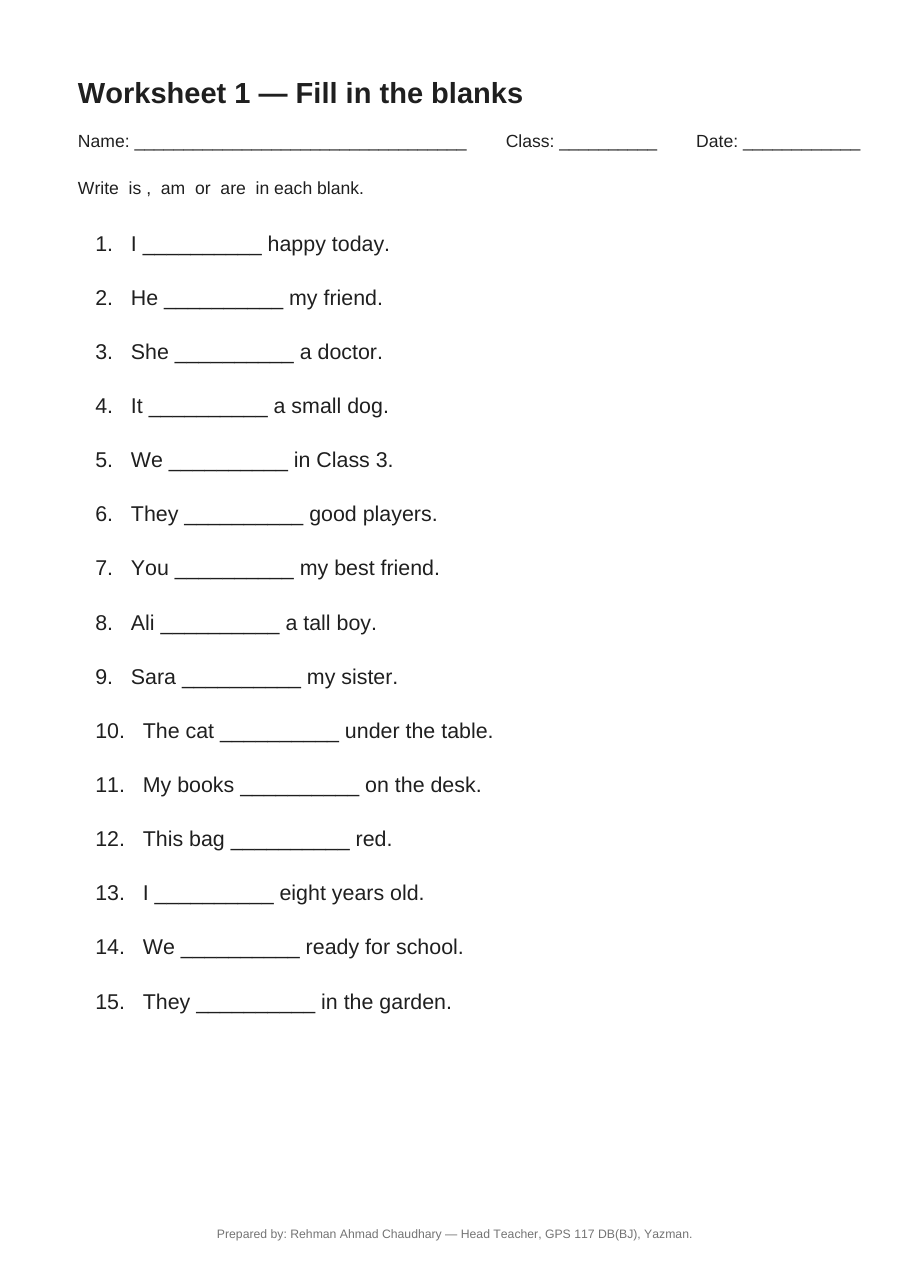
Page 2 — fill in the blanks (15 sentences). One verb missing per sentence, with subjects in a deliberate mix: I, he, she, it, we, they, you, names like Ali and Sara, and everyday nouns — the cat, my books, this bag. The vocabulary stays inside a young child’s world: family, school, animals, colours and jobs.
Page 3 — choose and circle (14 exercises). Ten sentences where the child circles the correct word from is, am or are, then four pairs of sentences where one is right and one is wrong — “She is a nurse” against “She are a nurse.” Spotting someone else’s mistake is a different skill from filling a blank, and children find it funny, which helps.
Page 4 — fix the mistake, then write your own (12 exercises). Eight sentences with a wrong verb to rewrite correctly — the classic “I is happy” included — followed by four guided prompts: a sentence about me, my friend, my school and my pet. This is where the pattern becomes the child’s own sentence, and it is the page I read most carefully when marking.
Page 5 — the answer key. Every answer for pages 2 to 4, in compact form for the teacher or parent. I built these is am are worksheets the way I build everything on this site: the questions were generated from the answer list and checked by program, so the key cannot disagree with the sheet. For the write-your-own page there are no fixed answers, only guidance — accept any sentence that uses the right verb and makes sense.
These are grammar worksheets for grade 3 at heart, but they work just as well for a strong Grade 2 class or a Grade 4 group that needs the basics repaired.
Two games that teach faster than a worksheet
Verb card race. Write IS, AM and ARE on three large cards and fix them to three walls. Read a sentence with the verb missing — “My books ___ on the desk” — and the class points, or runs, to the right wall. Wrong answers cost nothing, the whole class moves, and after ten sentences the pattern is in their legs as well as their heads.
Sentence chain. One child starts: “I am Ahmed.” The next adds a friend: “He is Ahmed, and I am Fatima.” The third: “She is Fatima, he is Ahmed, and I am Ali.” The chain grows until someone slips — then everyone helps fix it and the chain restarts. It is five minutes long, needs no materials, and children beg for it.
A note for Urdu-medium classrooms
Many of my children come from homes where one verb form covers what English splits into three, so “I is” is not a silly error — it is a sensible transfer from their first language. That is why these learners need more oral practice, not more correction. Let them hear and say fifty correct is am are sentences before you mark a single written one, keep the tone light when the mistake appears, and fix it by repeating the right sentence together rather than by circling the wrong one in red. The pattern is small; confidence is the real lesson.
The start of a free grammar series
This pack is the first in a new free English grammar worksheets series I am building for this site — the same approach each time: one small rule, taught orally first, then a printable pack with a checked answer key. Next in the series: was and were, has and have, and action verbs. If your class has a grammar topic that causes the same mistake every single week, that is exactly the kind of pack I want to build next.
Frequently asked questions
What is the rule for is, am, are?
Use am with I. Use is with he, she, it and any one person or thing (Ali is…, the cat is…). Use are with you, we, they and more than one person or thing (my books are…). One line to remember it: “I am, he is, they are.”
What grade are these worksheets for?
They are made for Grades 2 to 4. Grade 3 is the centre of the target — simple vocabulary, big print and short sentences — but a Grade 2 class that reads confidently can start them, and Grade 4 or 5 students who still mix up the verbs will finish them quickly and gain confidence.
Are answers included?
Yes. Page 5 of the PDF is a full answer key for the fill-in-the-blanks, choosing, circling and mistake-fixing exercises — these are is am are exercises with answers, checked against the questions by program before the pack was published. Only the final write-your-own sentences have no fixed answers, because any correct sentence counts.
How can I teach is/am/are to weak students?
Go back to the mouth before the pen. Chant “I am, he is, they are” with pointing, play the verb card race, and let the child build spoken sentences about real people in the room. Keep written work to two or three sentences at a time, all correct-verb practice, and praise the right verb loudly when it appears. Most weak students do not need a harder worksheet; they need more repetitions of an easy one.
Can I print these for my whole class?
Yes — that is what they are for. The pack is free to print for your whole class, your school, or your children at home. Print as many copies as you need, as often as you need.
Keep going
If you are planning this lesson properly, my lesson plan template with a filled example includes a complete Class 2 “Is, Am, Are” lesson plan — objectives, oral activities and assessment — that pairs directly with this pack. For the handwriting side of English class, my free handwriting practice worksheets use the same big-print, one-skill-at-a-time approach. And when I need free software for the school computer — a PDF tool, a typing tutor, a screen recorder — I look through FileCobra, where I keep the programs I actually use, free to download.
Print the pack, teach the chant tomorrow morning, and watch “I is” start to disappear by the end of the week.
Written by Rehman Ahmad Chaudhary — Head Teacher, GPS 117 DB(BJ), Yazman, Pakistan. I build these resources for my own classroom first and share them free for teachers everywhere.
