· Rehman Ahmad · 9 min read
Lesson Plan Template for Teachers (Free Printable, with a Filled Example)
The one-page lesson plan template I use as a government school head teacher: a blank printable, a weekly planner, and two filled examples you can copy — because inspectors want plans and teachers have no time.

Lesson Plan Template for Teachers (Free Printable, with a Filled Example)
Every government school teacher knows the register-book problem. Alongside the attendance register sits the lesson plan register — a thick book in which you are supposed to write, by hand, a full plan for every lesson you teach. An inspector can ask for it on any visit.
The problem is not planning — planning is the teaching. The problem is the format: pages of handwriting, written the night before, mostly copied from last year’s register, read by nobody. I did that for years. Then I shrank my plan to one page.
This page is that lesson plan template, free to print, with a weekly planner and two filled examples. It holds everything an inspector wants to see and everything I actually need at 8 a.m. — and nothing else.
Download the free lesson plan template (PDF) — blank daily template, weekly planner, and both filled examples, in one file.
What a good one-page plan actually holds
A plan is not an essay about your lesson. It is a checklist you can glance at while thirty children settle. In my experience, a useful lesson plan format needs only five things:
- Objectives first. One or two lines stating what pupils will be able to do by the end — not what the teacher will cover. “Pupils will shade and name equivalent fractions” is a target. “Teach fractions” is not.
- Timing on every stage. A 40-minute period disappears fast; when the warm-up is marked “5 min” on paper, it stops eating fifteen.
- Materials listed before the bell. Chart, strips, flashcards — finding out mid-lesson that the fraction wall is in the staff room helps nobody.
- An exit check. Two or three questions at the end that prove — or disprove — that the objective landed. This is the box most plans skip, and the only one that tells you what to do tomorrow.
- A reflection line. One honest sentence after the lesson: what worked, what to fix. Thirty seconds of writing that makes next year’s plan write itself.
What do I leave out? Script-style dialogue (“Teacher will ask… students will reply…”) and anything written purely to fill the register. If a line will never change what happens in the room, it does not belong on the page.
A walk through the template, box by box
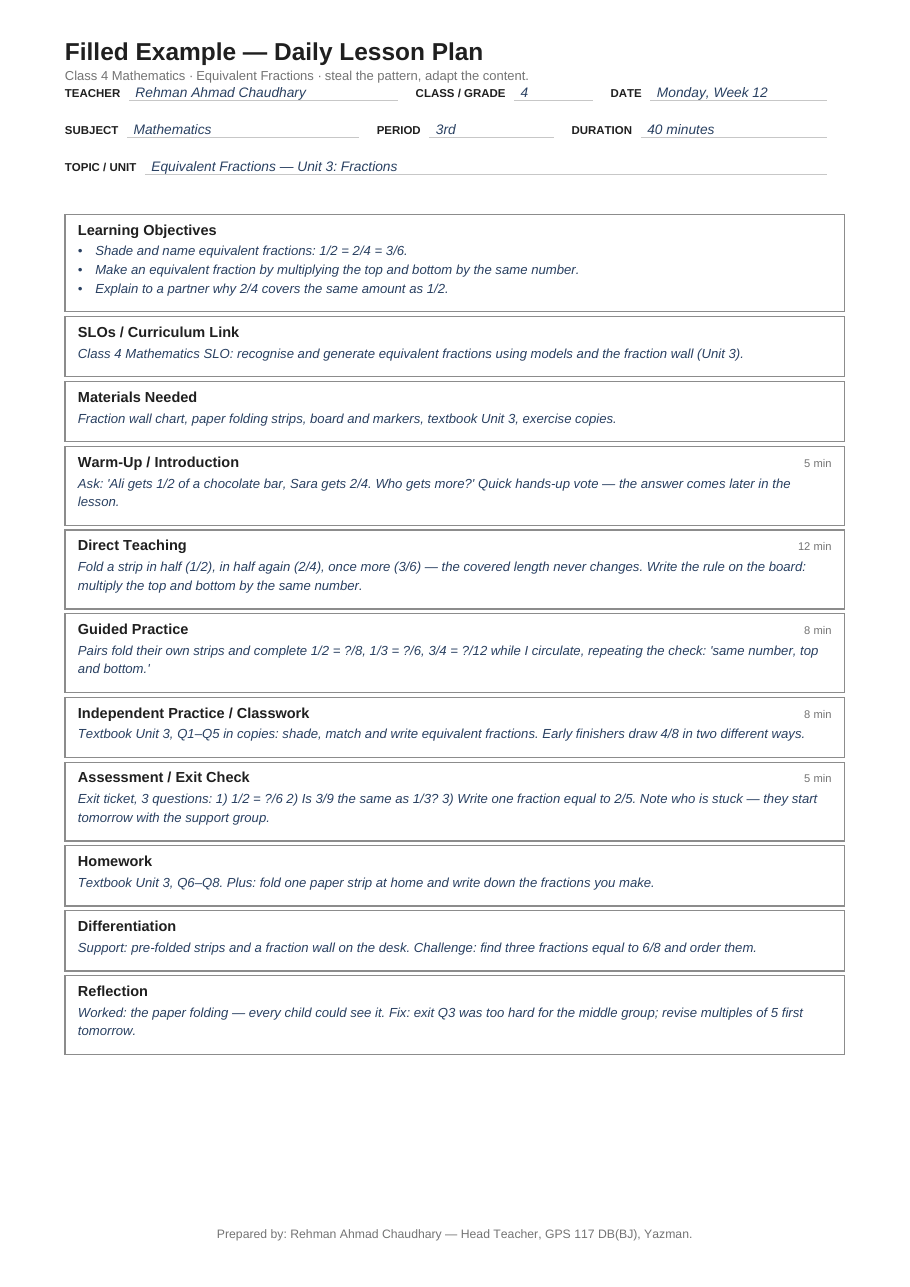
Header fields. Teacher, class, subject, date, period, duration, topic. Thirty seconds to fill — and what an inspector looks for first.
Learning Objectives. Three bullet lines, no more. If an objective will not fit in one line, it is two objectives wearing a coat. Start each with a verb a child can perform: shade, name, solve, read, write, explain.
SLOs / Curriculum Link. One line tying the lesson to the textbook unit or the syllabus’s student learning outcomes. This box exists for the record — it proves the lesson is not random.
Materials Needed. Everything for the lesson, listed before you leave home. This box saves the first five minutes of the period.
Warm-Up / Introduction (about 5 min). One question, one picture, one quick recap of yesterday. The best warm-ups create a small puzzle the lesson then solves — in the fractions example below, the children vote on who gets more chocolate, and do not get the answer until they have folded the paper themselves.
Direct Teaching. The main explanation and board work. Plan the example you will work on the board, not just the topic — one good worked example, written here in advance, is worth ten improvised ones.
Guided Practice. The class tries it with you — together, in pairs, with you circulating and correcting. This is where misconceptions surface while there is still time to fix them.
Independent Practice / Classwork. Children work alone in their copies. Write the exact textbook questions here, plus one stretch task for early finishers, so the fastest child is never the loudest problem in the room.
Assessment / Exit Check. Two or three questions, answered on slips or by thumbs up and down, in the last five minutes. Then note the names of the children who missed it — those names are tomorrow’s starter group.
Homework. Short, and from today’s lesson only. If it was not taught today, it is not homework — it is a punishment for parents.
Differentiation. One line of support (sentence starters, pre-folded strips, a chart on the desk) and one line of challenge. Writing it in advance is the difference between differentiation happening and it being just a word in your register.
Reflection. What worked, what to fix — one sentence each, written straight after the lesson while it is still true.
The filled examples — steal the pattern
The PDF includes two completed plans, because a blank daily lesson plan example teaches less than a filled one.
The first is mine from Class 4 Mathematics: equivalent fractions in 40 minutes. What to copy is the shape of it. The objectives are three single lines. The warm-up is one question with a vote. The direct teaching is built around one physical act — folding a paper strip in half, in half again, in half again — because Class 4 children believe their hands before they believe the board. The exit ticket is three questions, and the reflection admits one was too hard: that line tells me to revise multiples of five first next time.
The second example is shorter: Class 2 English, “is, am, are” in 35 minutes. What to copy here is the energy budget: a shouting game for guided practice, a thumbs-up exit check instead of written slips, and homework a six-year-old can do alone — three sentences about their family and one picture.
What to adapt is everything else: your textbook’s units, your period lengths, your examples. A lesson plan template for teachers is a skeleton — the bones stay the same; the lesson inside should be recognisably your class’s.
The fifteen-minute Sunday routine
The template’s second page is a weekly grid: five days, with subject, topic and homework columns. Here is how the whole week’s planning fits into fifteen minutes on Sunday evening:
- Topics first (5 minutes). Open the syllabus or textbook contents and fill only the Topic column for all five days. No activities, no detail — just the march of the week.
- Homework second (3 minutes). Add each day’s homework beside its topic. Doing this across the week stops the classic accident of heavy homework landing on the same day from three subjects.
- One daily page per lesson (7 minutes for the first, faster after). Each morning — or the evening before — pull one lesson off the weekly grid onto a daily page. Topic and homework are already decided, so the page is just objectives, stages and timings.
Notice what this routine does: the decisions happen once, on Sunday, and the daily page is only detail. Most teachers make every decision fresh each night — which is exactly why the register book feels endless.
One more habit has changed this job for me: I often draft the daily page with AI first, then cut it down into the template’s boxes. I described that method in AI tools for teachers to create worksheets — let the tool produce a rough draft, then edit it hard against your textbook. The template is where the draft becomes a plan.
Frequently asked questions
What should a lesson plan include?
At minimum: the class, subject and topic; one to three learning objectives; the materials you need; a short opening activity; the main teaching; guided and independent practice; a quick end-of-lesson check; and homework. The free lesson plan template above holds all of these on one page, plus differentiation and reflection lines — the two boxes that most improve the next lesson.
How long should a lesson plan be?
One page is enough for a single daily lesson, and for most teachers it is ideal. A daily lesson plan should be glanceable while you teach — if it runs to three handwritten pages, you will stop reading it, and a plan nobody reads is decoration. Save long writing for schemes of work and term plans, which are different documents.
Can I use this template for any subject?
Yes. The boxes are subject-neutral: objectives, materials, warm-up, teaching, practice, check, homework. The PDF proves it with one mathematics plan and one English plan side by side — and science teachers just put the demonstration in Direct Teaching.
Is the template free for my school?
Yes — download it, print it, photocopy it for your staff room. It is the same free lesson plan template I use in my own school. If your head teacher wants one plan format for the whole staff, this is a reasonable place to start; just keep the footer.
How do I write learning objectives quickly?
Use this frame: “By the end of the lesson, pupils will [verb] [content].” Pick verbs you can watch happening — solve, shade, label, read aloud. If you cannot picture a child doing it in the last five minutes, the verb is wrong. Three objectives maximum; one is often enough for a primary lesson.
Take back the register book
Planning was never the enemy — the endless handwriting was. One honest page per lesson satisfies the inspector, steadies the lesson, and leaves your evenings mostly your own. Download the template, fill one for tomorrow, and feel the difference.
For more of my classroom-tested resources, see the fractions worksheets for Grades 4–5 and my guide to planning lessons with AI. And when I need free software for the school computer — a PDF tool, a typing tutor, a screen recorder — I look through FileCobra, where I keep the programs I actually use, free to download.
Written by Rehman Ahmad Chaudhary — Head Teacher, GPS 117 DB(BJ), Yazman, Pakistan. I build these resources for my own classroom first and share them free for teachers everywhere.
