· Rehman Ahmad · 9 min read
Classroom Management Plan: A One-Page Template That Actually Works
The one-page classroom management plan a government school head teacher fills in during the first week of term: five positive rules, practised routines, specific praise and a calm consequences ladder - no shouting, no punishment.

Classroom Management Plan: A One-Page Template That Actually Works
In my first year of teaching, I spent the last week of the holidays preparing lessons - charts, notes, questions. By the Thursday of the first week, the class had quietly taken over. Children wandered, every instruction needed repeating five times, I was raising my voice by ten in the morning and exhausted by lunch, and my carefully prepared syllabus was barely moving.
My mistake was simple, and I see new teachers make it every year: I taught content before I taught routines. Children cannot learn in a room where nobody knows how to come in, how to line up, how to ask a question, or what happens when a rule breaks. Before the maths and the English, the class needs a system, written down.
That system is my classroom management plan. It fits on one page. I fill it in during the first week of term, pin it near my desk, and teach it the way I would teach a lesson. This article is that page, the thinking behind it, and the filled example from my Class 3 room.
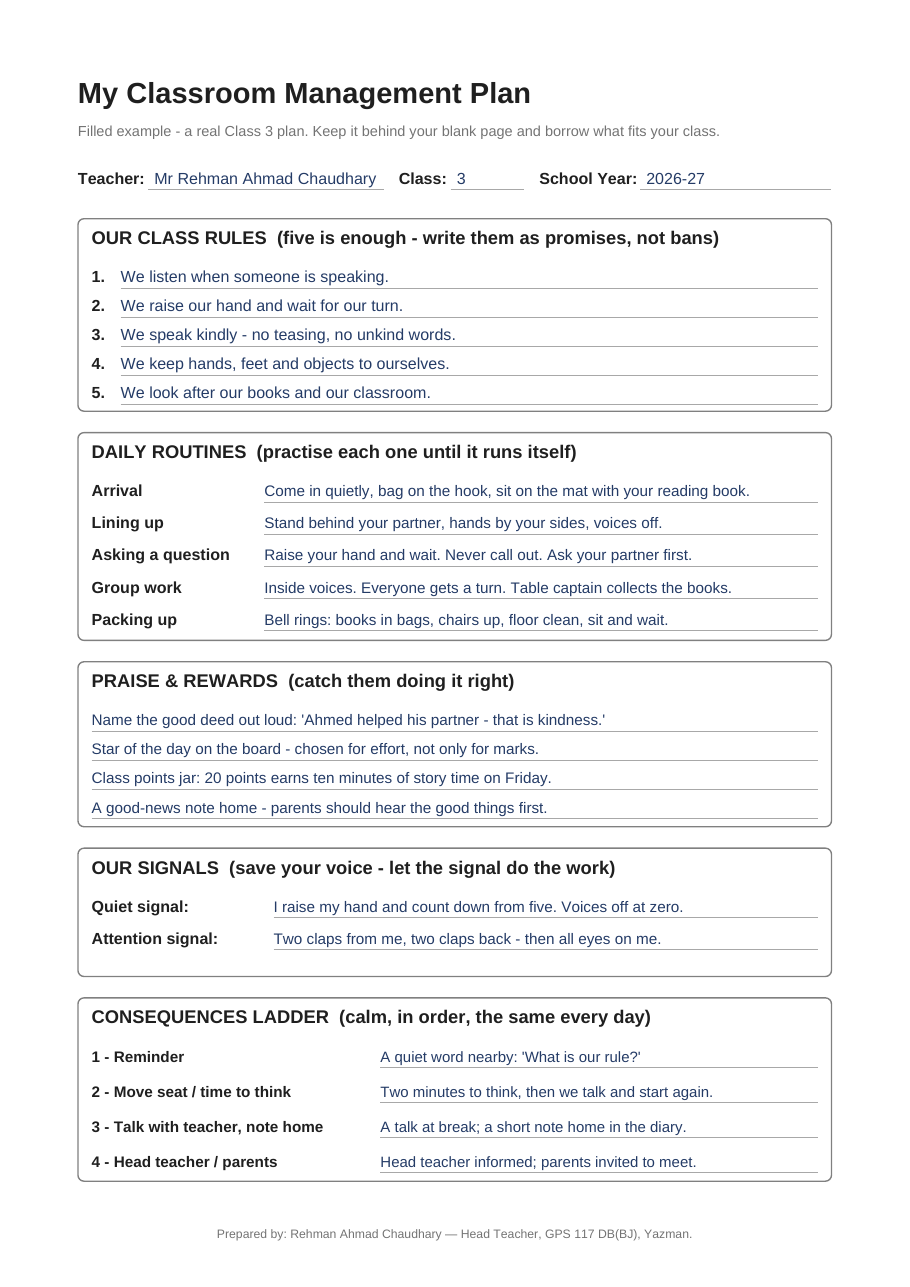
Download the classroom management plan template (PDF) - page 1 is blank, to fill in by hand; page 2 is the same plan filled in for Class 3, wording and all.
The four pillars of the plan
Teachers collect classroom management strategies the way children collect stickers, and most of them fade by October. What survives is not a trick; it is four boring pillars, done the same way every day.
1. Rules - few, positive, in child language
Five rules. Never more. A child cannot remember fourteen rules, and a teacher cannot enforce them. Each rule is a promise, not a ban: “We listen when someone is speaking,” not “Don’t talk.” Positive wording tells the child what to do.
We write the rules together on the first day, in the children’s own words, and I keep their language even when mine would sound grander. The five on the filled example are the classroom rules examples I use: listen when someone is speaking; raise your hand and wait; speak kindly; keep hands, feet and objects to yourself; look after our books and our classroom. That short list covers almost everything in a school day.
2. Routines - practised like a lesson
Rules tell children how to behave. Routines tell them how the day runs, and routines are where the real time is saved. Arrival, lining up, asking a question, group work, packing up - each is a small procedure with steps, taught the way you would teach anything else: show it, practise it, praise it, repeat it tomorrow.
We practise lining up. We leave the room, come back in, and do it again until it is smooth - and the children treat it as a game, not a punishment. A routine practised three times in the first week runs itself for the rest of the year. A routine you never taught must be re-explained every day, in a rising voice.
3. Praise - specific and public
Praise is the engine of the whole plan; vague praise is almost useless. “Good boy” tells a child nothing. “Ahmed helped his partner with the sum - that is kindness” tells the whole class which behaviour earns attention here. Name the deed, name the child, say it out loud for all to hear.
Correct behaviour gets my loud, public attention. Wrong behaviour gets a quiet word close to the child, barely noticed by the rest. Most teachers run this the other way round - silent when the class is good, loud when it is not - and then wonder why noise gets the attention it seeks.
4. Consequences - a calm ladder, the same every day
When a rule breaks, I do not invent a punishment on the spot. I climb a ladder, one step at a time, in the same order daily: a reminder, a move of seat with time to think, a talk with me and a note home, and only then the head teacher and parents.
There is no corporal punishment in this ladder, and there never will be - it is banned, it is wrong, and it buys one quiet afternoon at the cost of a frightened class all year. There are no shouting matches either. A predictable ladder is stronger than a raised voice: the consequence arrives calmly, certainly, and without anger. Children test it in week one; by week three, most days end on step one.
Inside the template
The blank page has six parts. The header is your name, class and school year. The rules box gives five numbered lines with small prompts (“We listen when…”) to start your thinking. The routines table lists the five moments that cause most primary-school disorder, with a line each for your version.
In the praise box you write down, in advance, how you will reward effort - deciding this in calm September beats inventing rewards in a noisy November. The signals box may be the most valuable two lines on the page: a quiet signal and an attention signal, agreed with the class, so your voice stops being a tool you spend all day. The ladder comes pre-labelled, with a blank line beside each step for your own wording.
Page 2 is my real Class 3 plan, wording and all - borrow any line that fits your room.
The first week: teach the plan day by day
- Day 1: Arrival and lining up; practise both, twice. Agree the five rules together and chart them.
- Day 2: Asking a question - hand up, wait, no calling out. Teach the quiet signal and practise it until the class is silent inside ten seconds.
- Day 3: Group work. Inside voices, everyone gets a turn, and introduce table captains, who collect books and materials.
- Day 4: Packing up and the end-of-day routine. Start the class points jar; praise routines followed, loudly and by name.
- Day 5: Run the whole day on the plan. Practise any routine that wobbles, cheerfully. End by celebrating: the class has learned how this room works.
Big classes: fifty children, one teacher
Most advice on classroom management for elementary teachers quietly assumes twenty children and a teaching assistant. My reality is fifty-plus children and one teacher. The plan matters more in a big class, not less - you lean harder on three parts of it.
Lining up happens in pairs with a line leader at the front and a responsible child at the back; I stand in the middle, where noise starts. The quiet signal earns its keep: a raised hand and a countdown costs me nothing, while shouting over fifty children costs my voice by Wednesday and my temper by Friday. And monitors multiply the teacher: a book monitor, a floor monitor, a board monitor - weekly-rotating jobs children take seriously because they are real jobs.
Mistakes I have made
- Too many rules. Fourteen, one year, beautifully written on a chart. Nobody - including me - could remember rule nine.
- Threats I would not keep. “I will call your father to school.” The children knew it was an empty threat before I did, and every later threat sounded emptier.
- Punishing the whole class. Keeping fifty children in at break because two were noisy punishes the forty-eight who behaved, and teaches them behaving changes nothing.
Frequently asked questions
How many rules should a class have?
Four to six. Five works best in my rooms. Each rule should be positive, short enough for a seven-year-old to repeat, and broad enough to cover a whole family of behaviour. If a problem fits under none of your rules, a rule is worded too narrowly - not missing.
What consequences work without punishment?
The calm ladder: a reminder, thinking time away from the group, a talk with the teacher, a note home, and parents only when the earlier steps have genuinely been tried. A connected lost privilege - tidying the shelf you messed - also works. Anything meant to frighten or hurt does not.
How do I handle a noisy class?
Never try to out-shout fifty children; you will lose, and your voice pays for it. Use the agreed signal, then wait in silence, however long it feels at first. When the class settles, name and praise the first table that went quiet - then practise the signal again that day, as a game.
Should parents see the plan?
Yes. I send the rules home in the first week - a short note in the diary or a copy of the chart. Parents who understand the ladder rarely object to a note home - they become partners in it, which is what the note is for.
Does this work for big classes?
This plan was built in big classes - fifty and more, one teacher, no assistant. Routines, signals and monitors are not extras for a crowded room; they are how one adult runs it calmly. The smaller the class, the more you can improvise. At fifty, the plan is what saves you.
One page, in your head
A long behaviour policy sits in a file and helps nobody at half past ten on a noisy Tuesday. A classroom management plan on one page lives in your head: five rules, five routines, praise first, a calm ladder. Download it, fill it in on the first morning, and teach it in week one like the most important lesson of the year - the others stand on it.
The plan works alongside your daily planning: my lesson plan template with a filled example is the matching one-pager for the teaching itself. If handwriting is your battle, the free handwriting worksheets pack is the set my classes use. And for free software for the school computer - a typing tutor, a timer, a PDF tool - I look through FileCobra, where I keep the programs I actually use.
Written by Rehman Ahmad Chaudhary — Head Teacher, GPS 117 DB(BJ), Yazman, Pakistan. I build these resources for my own classroom first and share them free for teachers everywhere.