· Rehman Ahmad · 8 min read
Free Printable Worksheets for Grade 1: A Starter Pack (Letters, Numbers, Shapes)
A free Grade 1 starter pack from a head teacher's classroom: eight gentle pages of letters, numbers, shapes and matching games for five- and six-year-olds, built for confidence first and skills second.

Free Printable Worksheets for Grade 1: A Starter Pack (Letters, Numbers, Shapes)
Every September I watch the same scene in my school. A five-year-old arrives holding a parent’s hand a little too tightly, meets a classroom of strangers, and is expected — within weeks, it sometimes feels — to read, write and count. The parents worry. The child worries. And well-meaning adults reach for the thickest workbook they can find, as if the answer to a nervous first month is more pages.
It is not. In my experience, what a child in the first school months actually needs is small wins, often. A letter traced successfully. A number recognised without help. A page finished and shown proudly to someone at home. Confidence comes first; the skills grow on top of it, quietly and quickly, once a child believes school is a place where they can succeed.
That belief is what I built this pack on. It is a set of free printable worksheets for grade 1 — eight pages only, deliberately — covering the first letters, the first numbers, basic shapes and simple matching games. Big print, few questions per page, lots of empty space for small hands that are still learning how hard to press a pencil.
Download the pack: Grade 1 Worksheets Starter Pack (PDF) — eight pages, free for home and classroom use.
Readiness matters more than rushing
Before any worksheet, there are three quiet skills that decide how a Grade 1 child settles, and none of them appears on a test.
The first is pencil grip. A child who holds a pencil in a fist will tire in two minutes and decide writing is hard. A relaxed three-finger grip — thumb and first finger pinching, middle finger resting underneath — can be practised with crayons, chalk and even picking up small objects, long before formal writing begins.
The second is sitting for ten minutes. Not an hour. Ten minutes of staying with one gentle task is a real achievement at five, and it is trainable: short activities, finished properly, one at a time.
The third is recognising their own name. It is the first word most children truly own, and seeing it — on a bag, on a peg, on a worksheet — tells a child: this place knows you. That is why the last page of this pack is a name page.
If your child is still working on these three, the pack can wait a week. Readiness is not delay. It is the foundation everything else stands on.
Inside the starter pack
The eight pages move in the order I would use them in class:
- Cover page — the child’s name, class and school, what is inside, and a short note for parents and teachers about how to use the pack kindly.
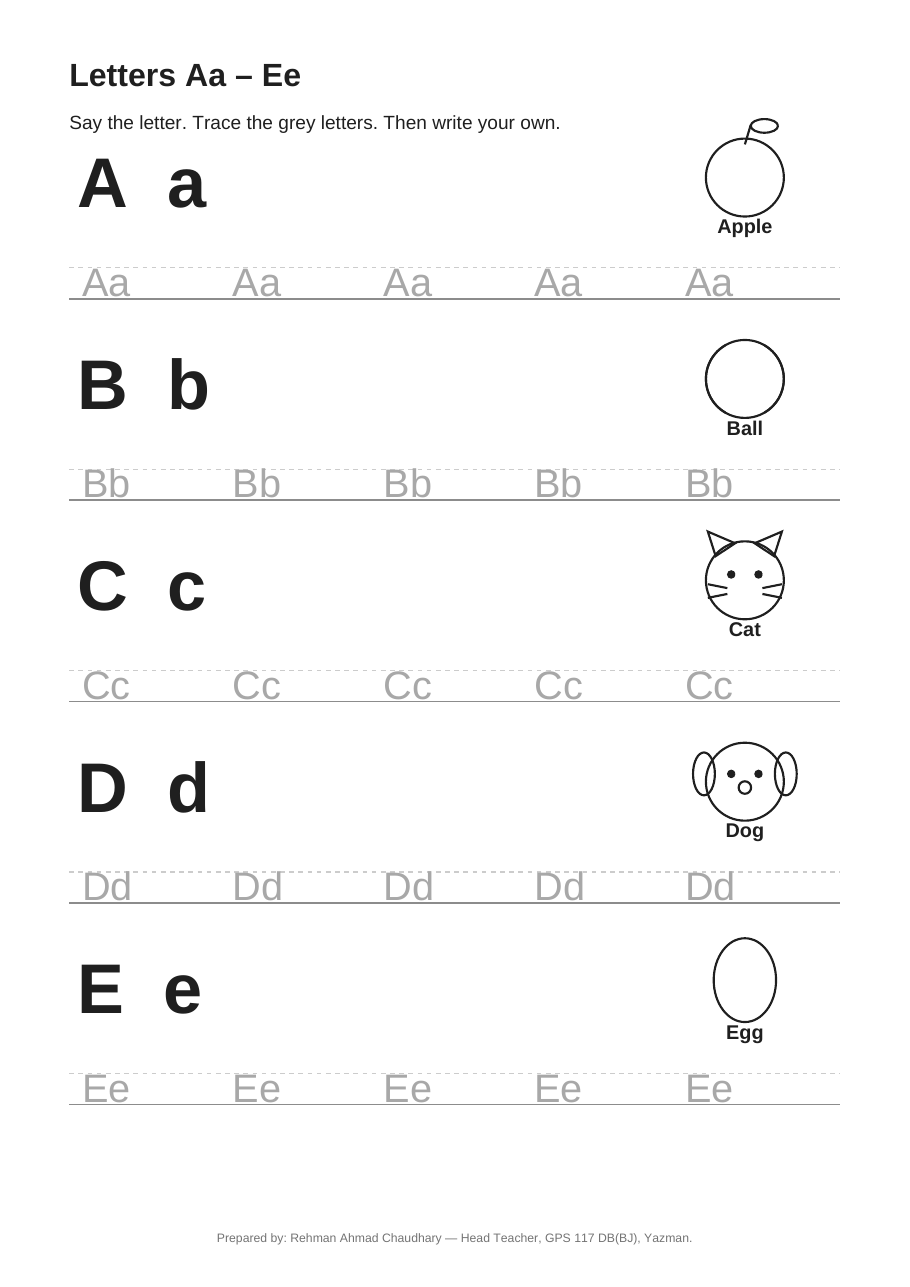
- Letters Aa to Ee and Ff to Jj — the first ten letters, each with its small partner, one simple picture word (A for Apple, B for Ball, C for Cat) and a row of grey letters to trace. These are the grade 1 english worksheets in the pack: recognition and tracing, nothing more demanding.
- Numbers 1 to 5 and 6 to 10 — a big numeral to trace, then a count-and-circle exercise: count the stars or apples and circle the right number out of three. These are the grade 1 maths worksheets — counting with real objects pictured on the page, the way early number sense actually forms.
- Shapes and colours — circle, square, triangle and star, each with one clear instruction: “Colour the circle red.” Tracing the shape and following the instruction are two skills in one gentle task.
- Match and join — big letters A to E joined to their small partners, and the number words one to five joined to their numerals. Matching games feel like play, which is exactly why children repeat them willingly.
- All about me — trace “My name is”, write it yourself, draw a picture of yourself, and colour one star on the star chart for every day of practice.
If you are searching for worksheets for grade 1 pdf format specifically, that is what the download is: one printable PDF, eight pages, black and white friendly, with the answers visible on the page for the counting games — at this age a parent checking alongside the child matters more than a separate answer key.
How to use the pack at home
One page a day is a good rhythm. Ten to fifteen minutes, at a table, with a real pencil — and stop while it is still fun. A page finished smiling teaches more than three pages finished in tears, because the child returns willingly tomorrow.
Praise the effort before the answer. “You sat and finished the whole row” builds more than “good, that is correct” — correctness will follow effort, but effort rarely follows correction alone. If a page goes badly, that is information, not failure: the child may be tired, or the step may be a week too early. Put the pack away and bring it back another day; it will still be free.
How teachers can use it in class
For teachers, I would use this pack in three places. First, the settling-in weeks: short, achievable pages while routines are being learned and you are still discovering who can hold a pencil and who cannot yet. Second, fast finishers: the matching and shapes pages keep early finishers happily occupied without racing them into next term’s work. Third, homework parents can actually help with — every page explains itself, so a parent with little English, or little schooling, can still sit beside the child and encourage. Homework that excludes parents helps nobody.
One gentle warning
Worksheets support learning at this age; they must never replace the things that matter more. A five-year-old learns language by talking and being talked to, learns stories by hearing them, learns how the world works by playing in it. No pack of grade 1 worksheets, mine included, can do those jobs. If the choice on a given afternoon is between a worksheet and twenty minutes of play, conversation or a story — choose the story, every time, and do the page tomorrow.
Frequently asked questions
What should a Grade 1 child learn first?
Settling comes before syllabus: recognising their own name, holding a pencil comfortably, sitting with a task for about ten minutes, and knowing the first letters and numbers by sight. The pack starts exactly there — letters Aa to Jj, numbers 1 to 10, basic shapes — because those are the foundations every later skill stands on.
How many worksheets a day is right?
One page a day, for ten to fifteen minutes, is plenty for a five- or six-year-old. Short and daily builds a habit; long weekend marathons build resistance. If your child asks for a second page, that is a good day — let them. If they resist the first page, make it shorter, not stricter.
My child cannot hold a pencil properly yet — what helps?
Start away from the worksheet: chunky crayons, chalk on a wall or floor, drawing in sand or flour with a finger, squeezing and pinching play. When you do sit down together, model the three-finger grip slowly and let the child copy; thick pencils are easier for small hands. If gripping is still very difficult after a few months of gentle practice, mention it to the class teacher — early noticing helps.
Are these worksheets free for classroom use?
Yes. Download the free printable worksheets for grade 1 pack once and print as many copies as your class needs; it is free for home and classroom use. Every page carries my name and school because I make these for my own children first — you are welcome to share the file with other teachers and parents as it is.
What comes after this pack?
When tracing single letters feels easy, move to letter formation and early handwriting practice with my free handwriting worksheets, which use guided four-line rows. When counting to ten is solid and your child is a year or two older, the times table target circles worksheets turn multiplication into a game with fading help and full answer keys.
A small start, made properly
The first term of school sets the tone for years, and the tone that works is: small steps, finished well, praised honestly. That is all this pack tries to give you — eight pages, in the right order, at the right size for small hands.
And when the school computer needs free software — a PDF reader, a typing tutor for older children, an offline dictionary — I keep the programs I actually use collected at FileCobra, free to download.
Written by Rehman Ahmad Chaudhary — Head Teacher, GPS 117 DB(BJ), Yazman, Pakistan. I build these resources for my own classroom first and share them free for teachers everywhere.
