· Rehman Ahmad · 7 min read
Times Table Target Circles Worksheets (Tables 2–10): Free Printables That Build Real Recall
Free printable target circles worksheets for the 2 to 10 times tables. Each sheet has 54 mixed-order questions, help that fades row by row, and a no-help Star Challenge — so children learn real recall, not just chanting.
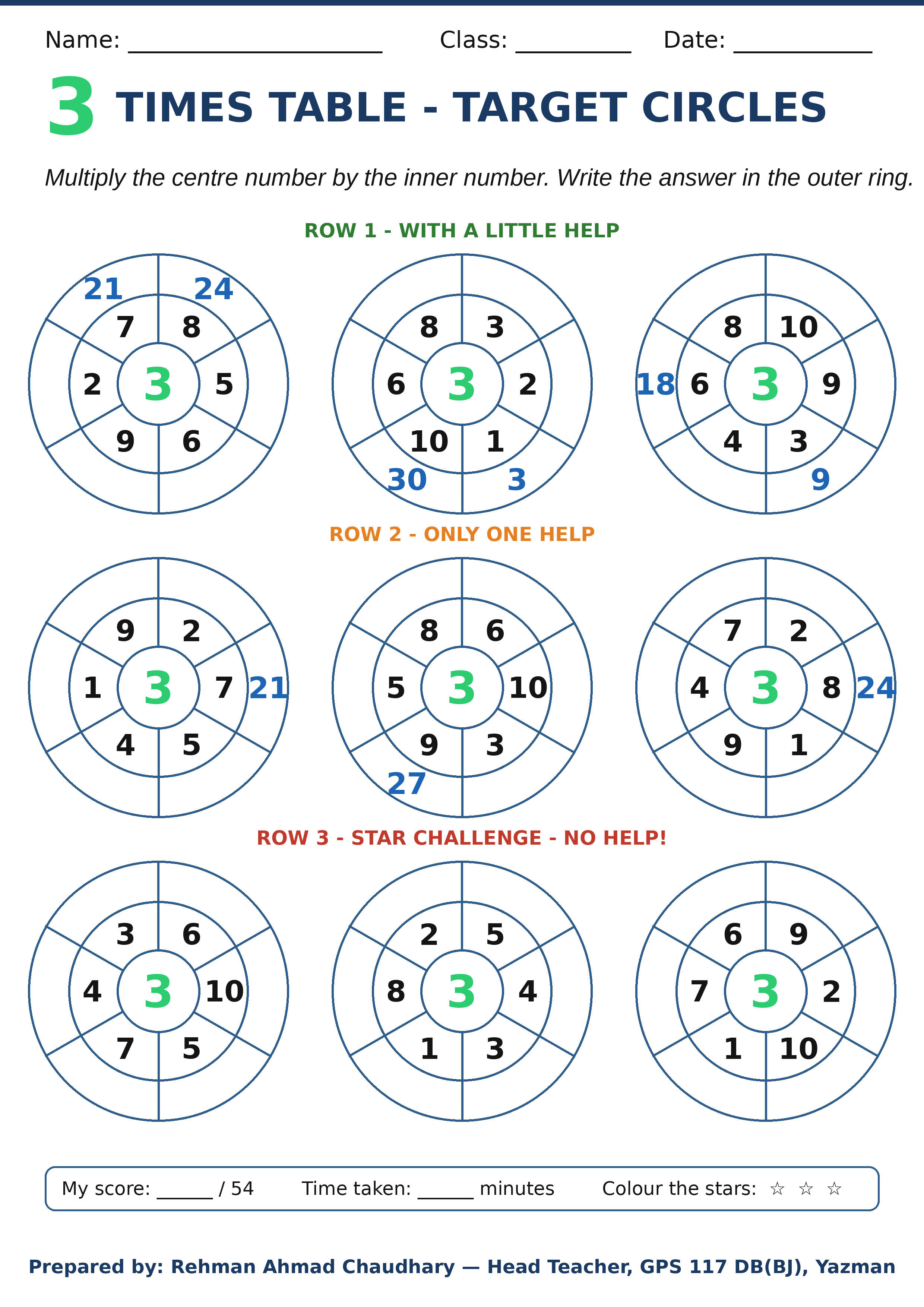
Times Table Target Circles Worksheets (Tables 2–10)
Ask a class to recite the 7 times table and many children can sing it: 7, 14, 21, 28… Then ask one simple question on its own — what is 7 × 8? — and the singing stops. The child starts counting from the beginning of the song until he reaches the answer, or gets lost on the way.
That is the difference between sequence memory and real recall. Chanting teaches the order of the answers. It does not teach a child to look at 7 × 8 and simply know it is 56.
These free target circles worksheets are built to close exactly that gap. I made them for my own primary-school classroom, and I am sharing them here for teachers, parents and homeschoolers anywhere in the world.
Play the target circles game online
Pick a table and play right here in your browser — 9 circles, 54 questions, instant checking, and stars at the end:
Type each answer in the outer ring — green means correct. Finish all 9 circles!
Prefer paper? The printable worksheets are all below.
What is a target circle?
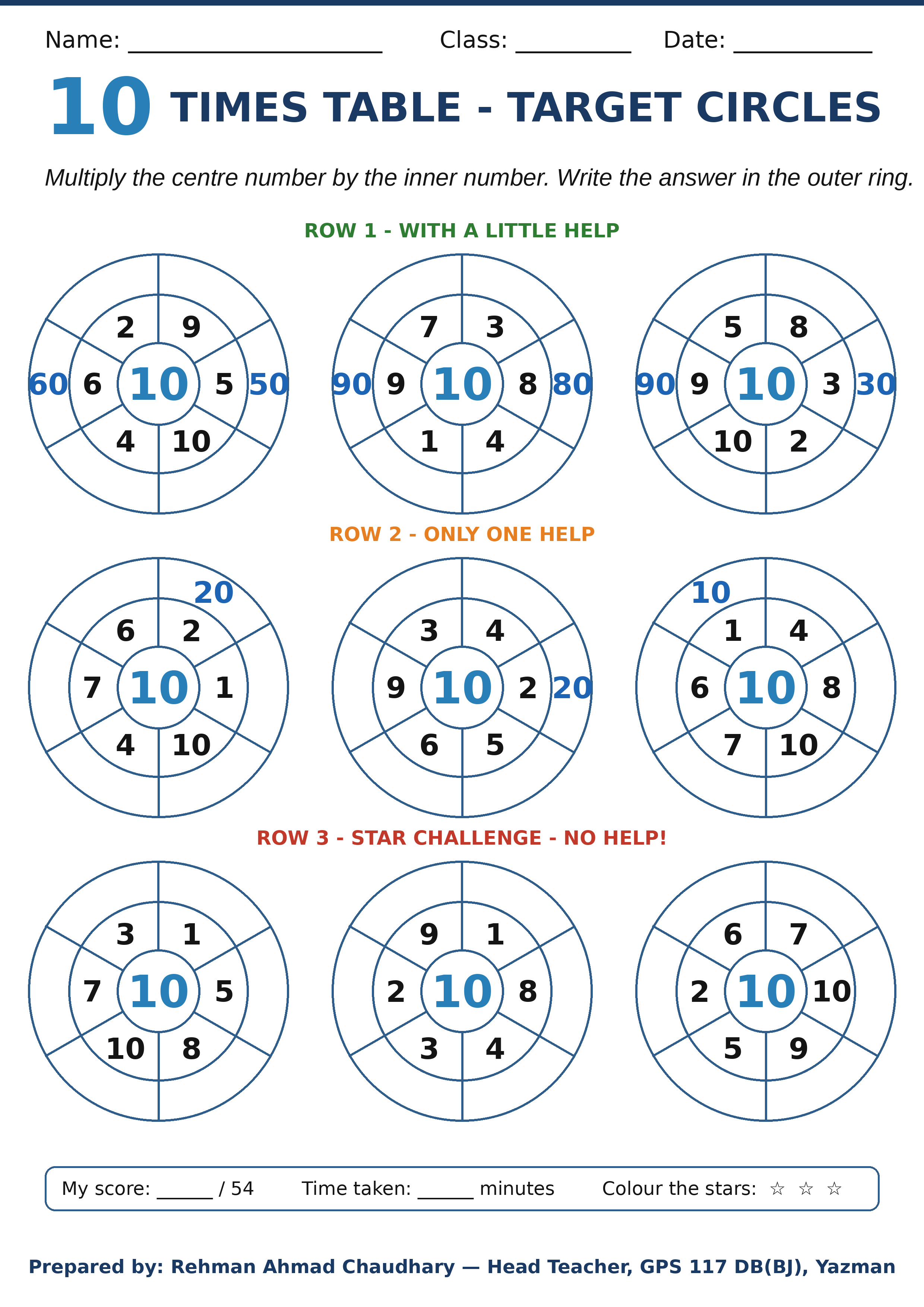
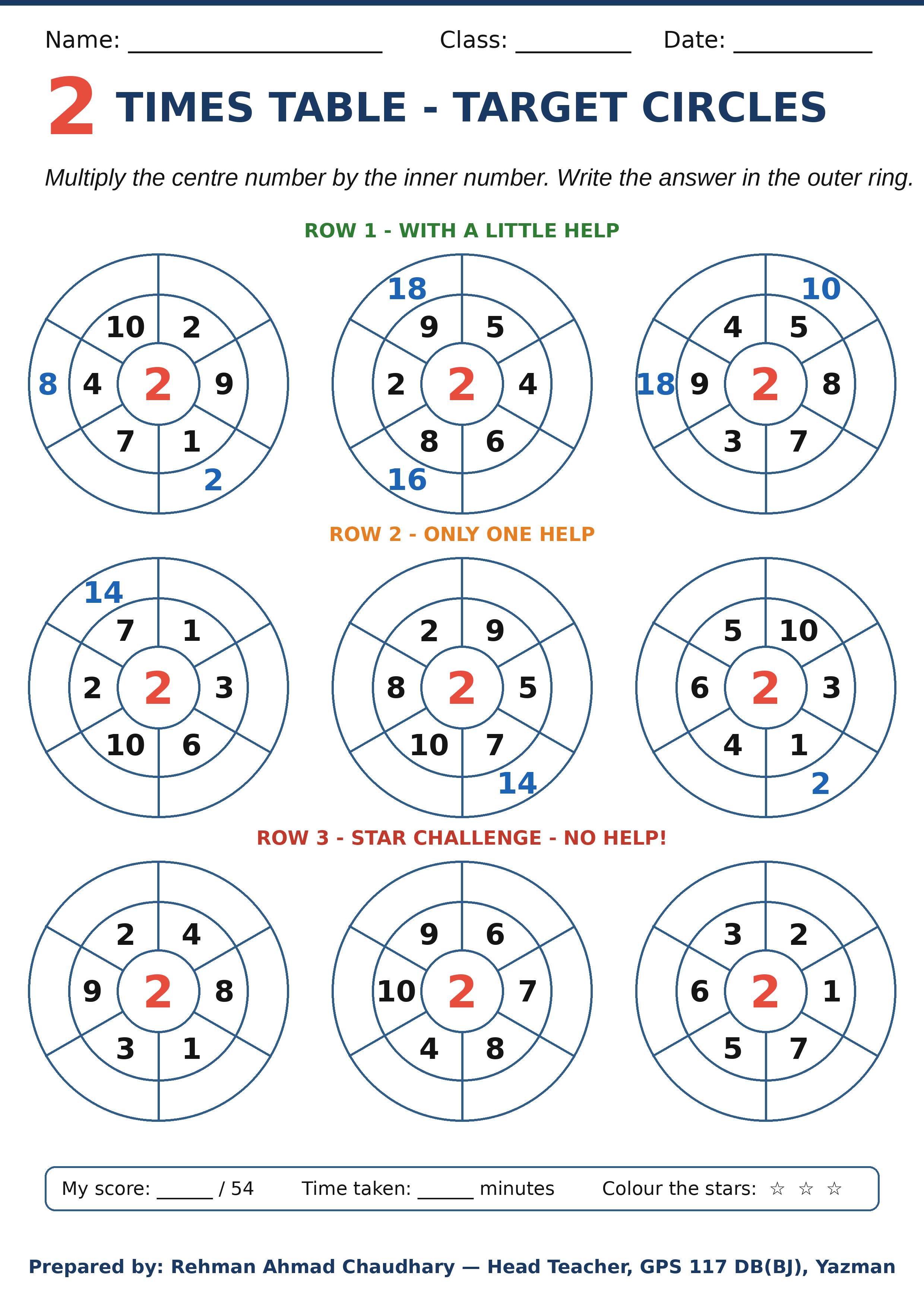
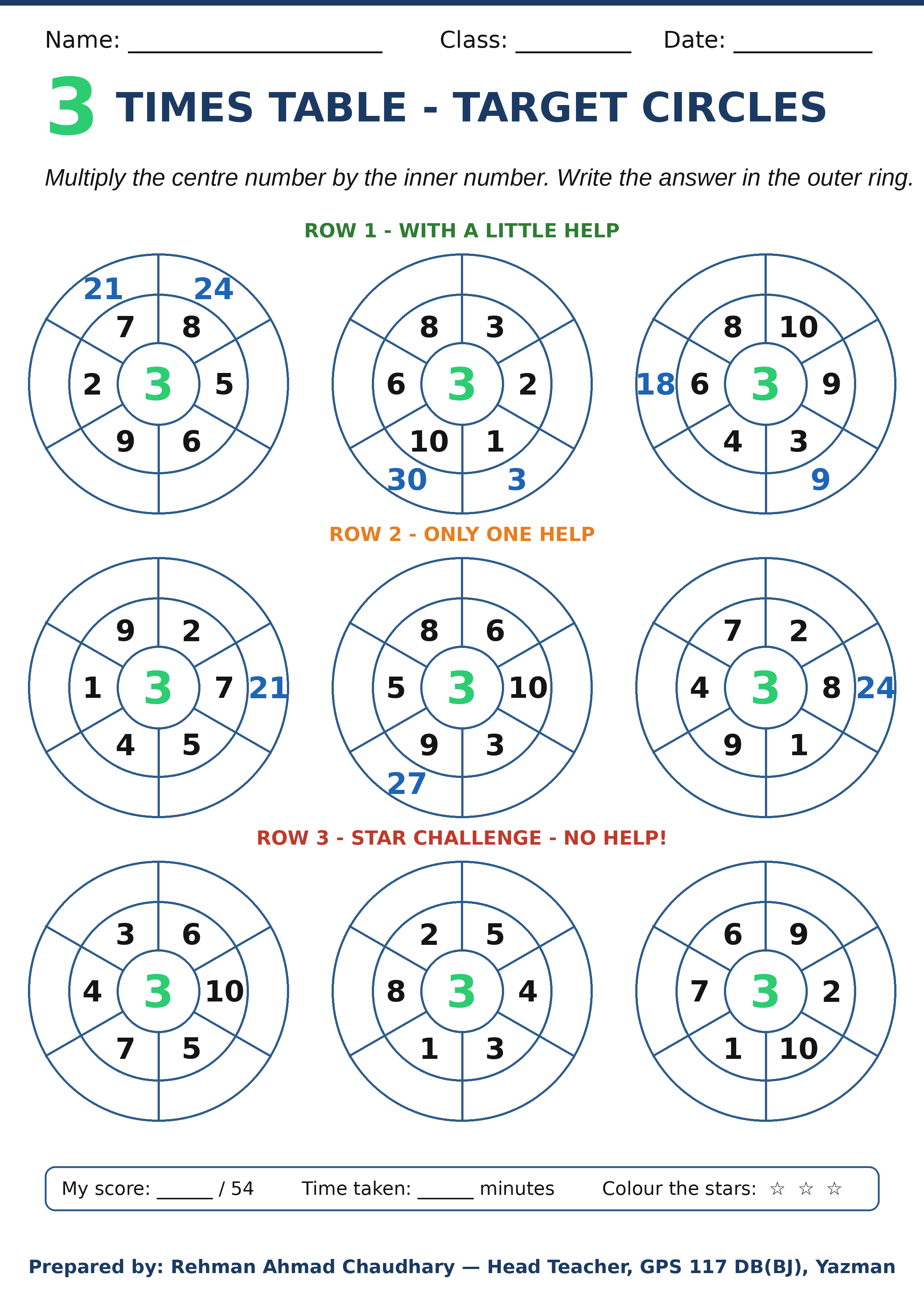
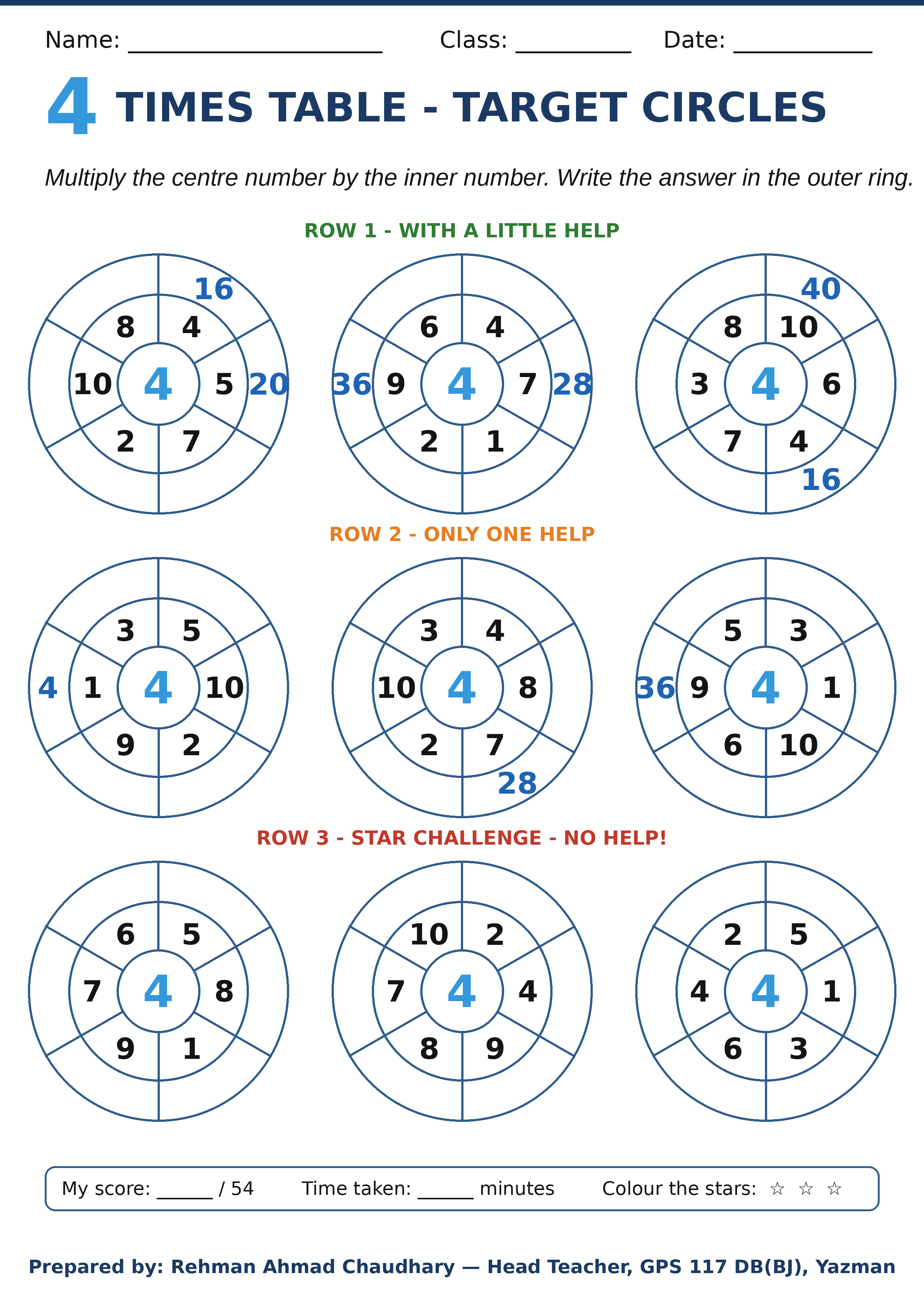
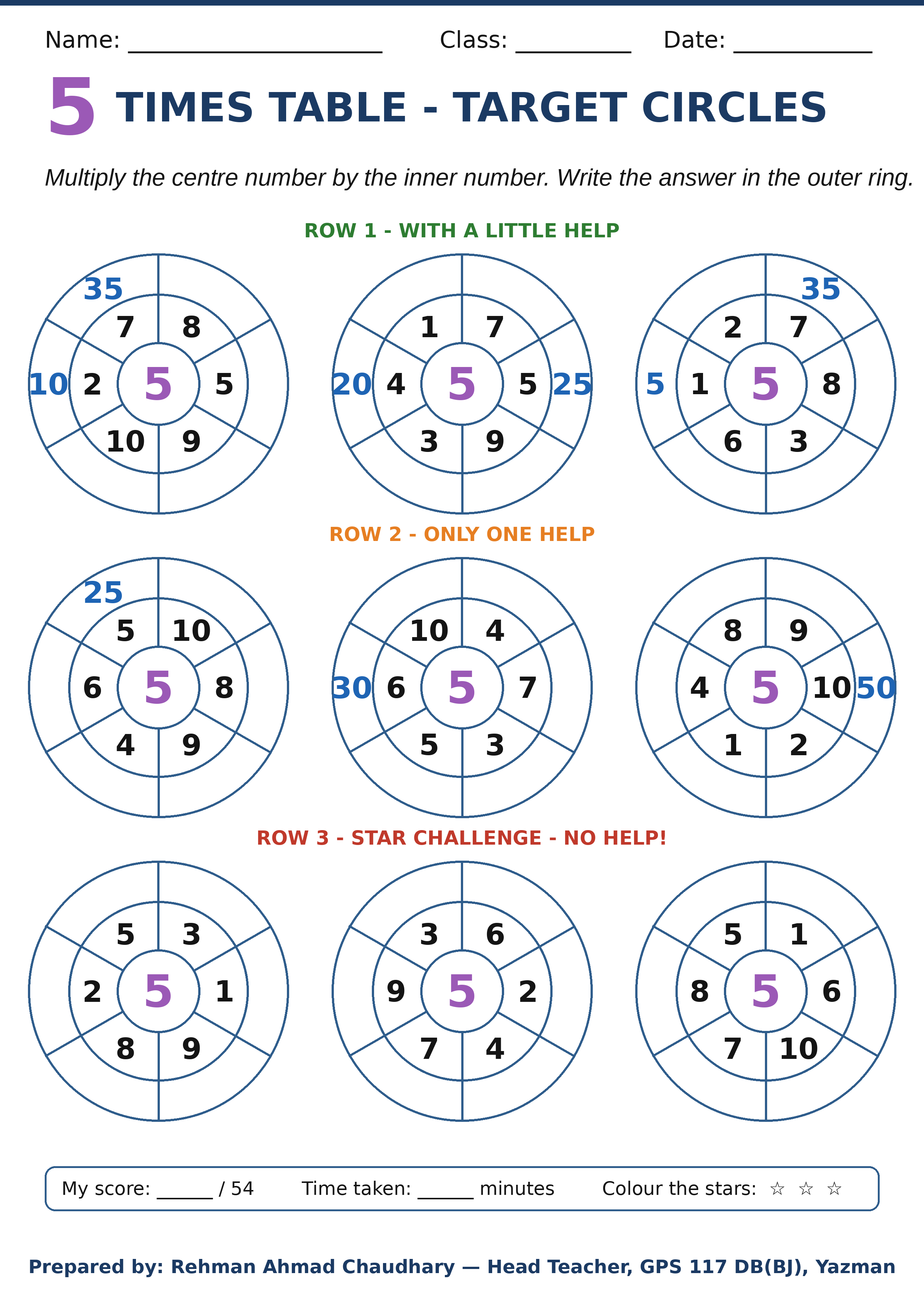
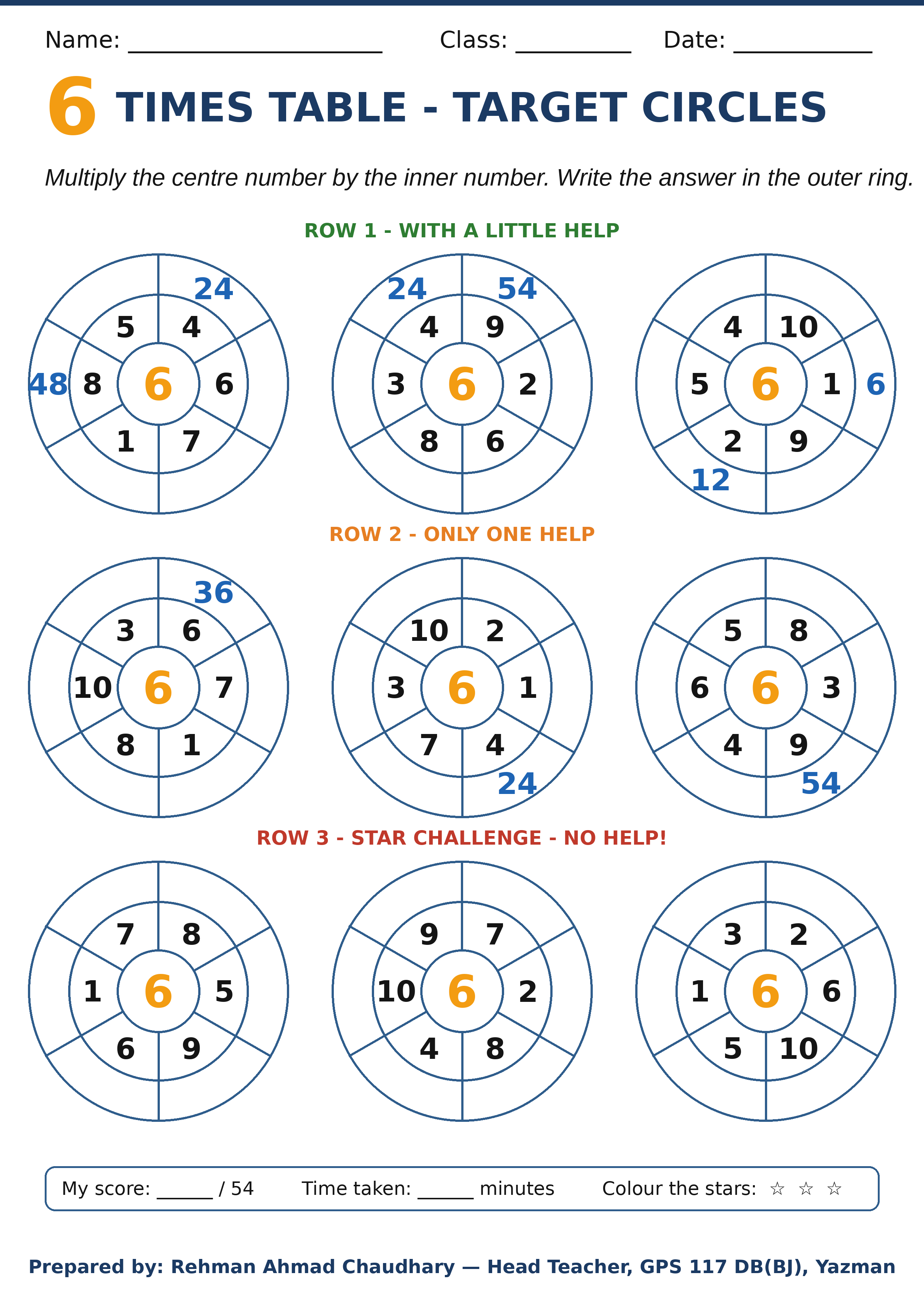
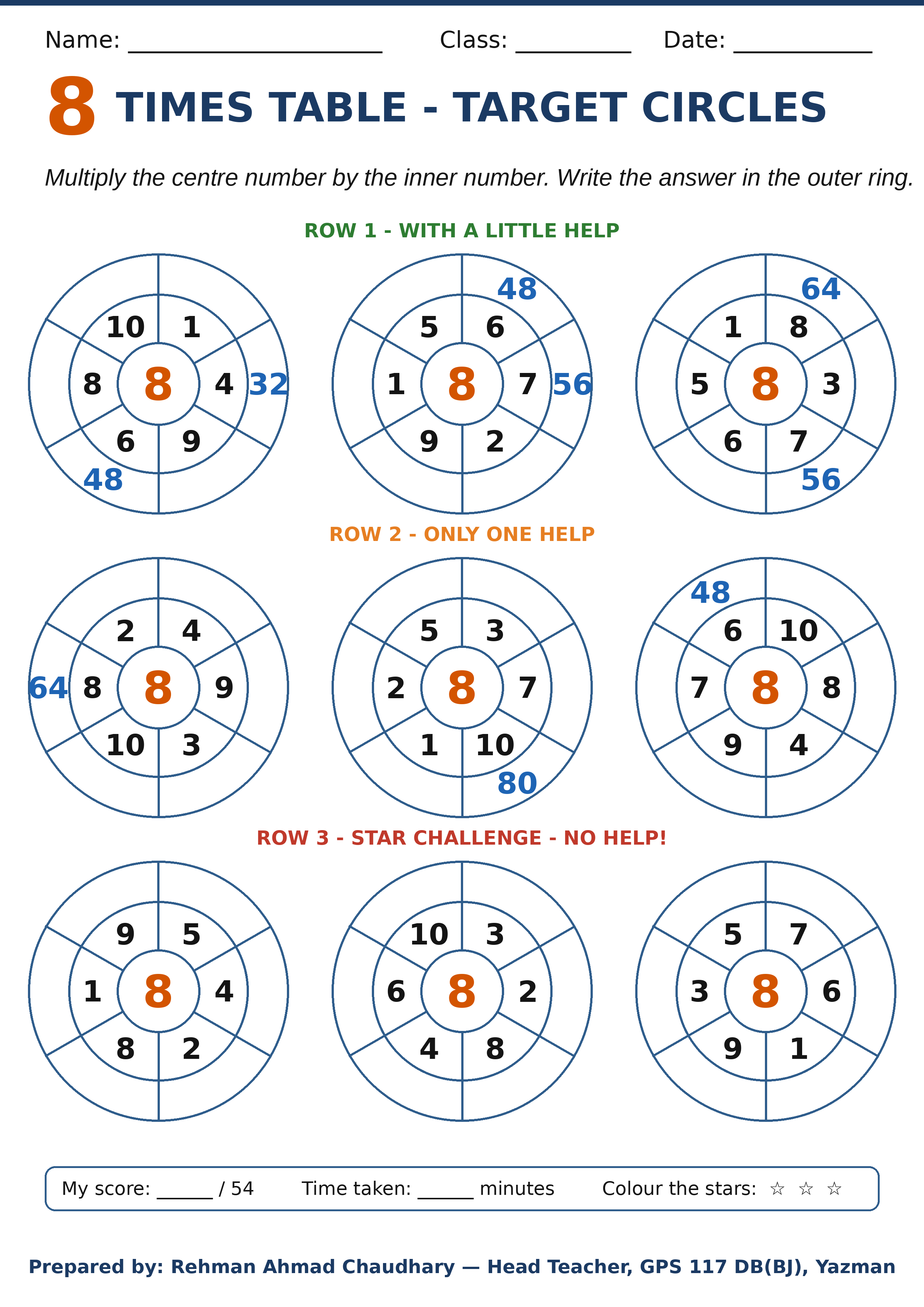
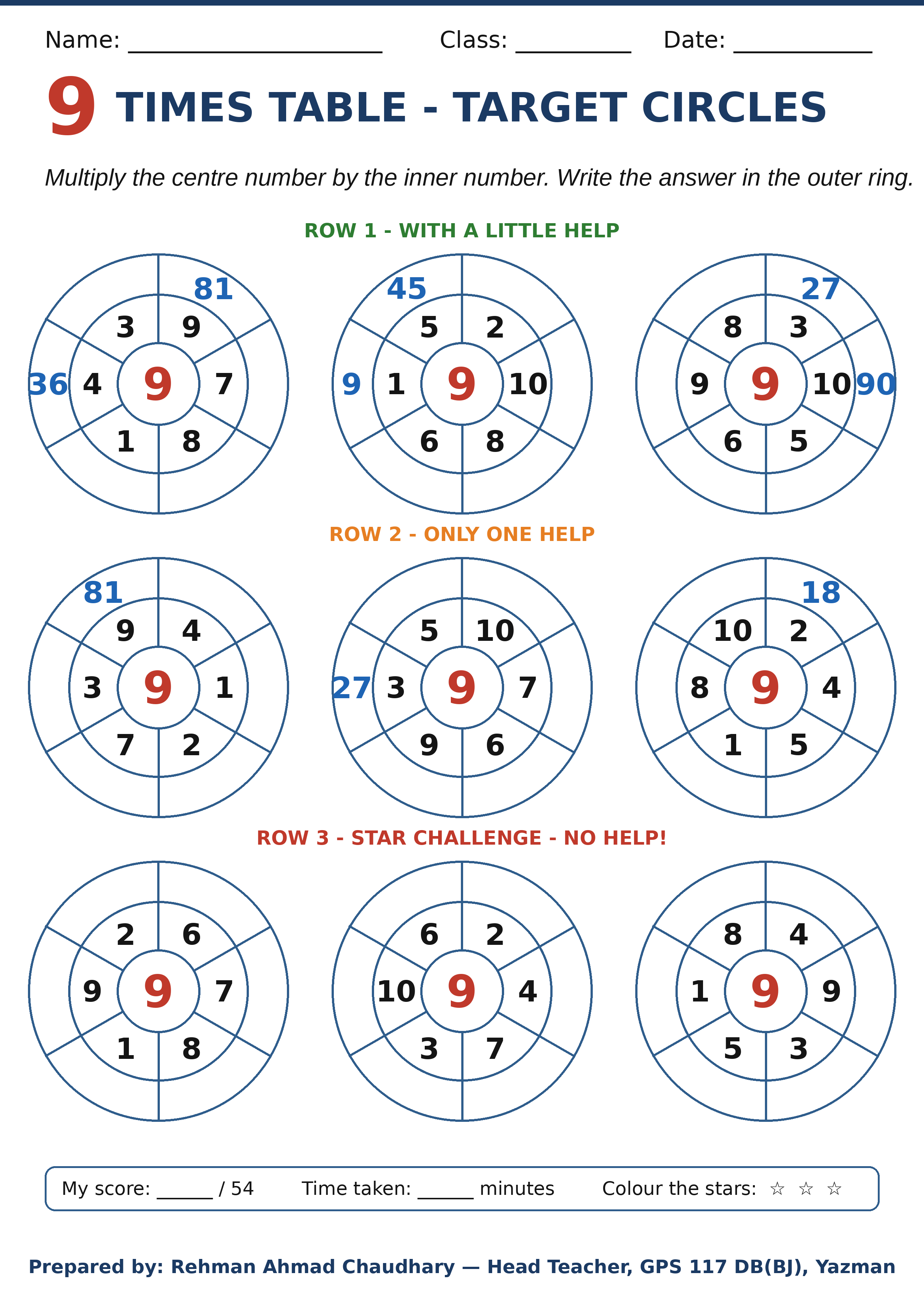
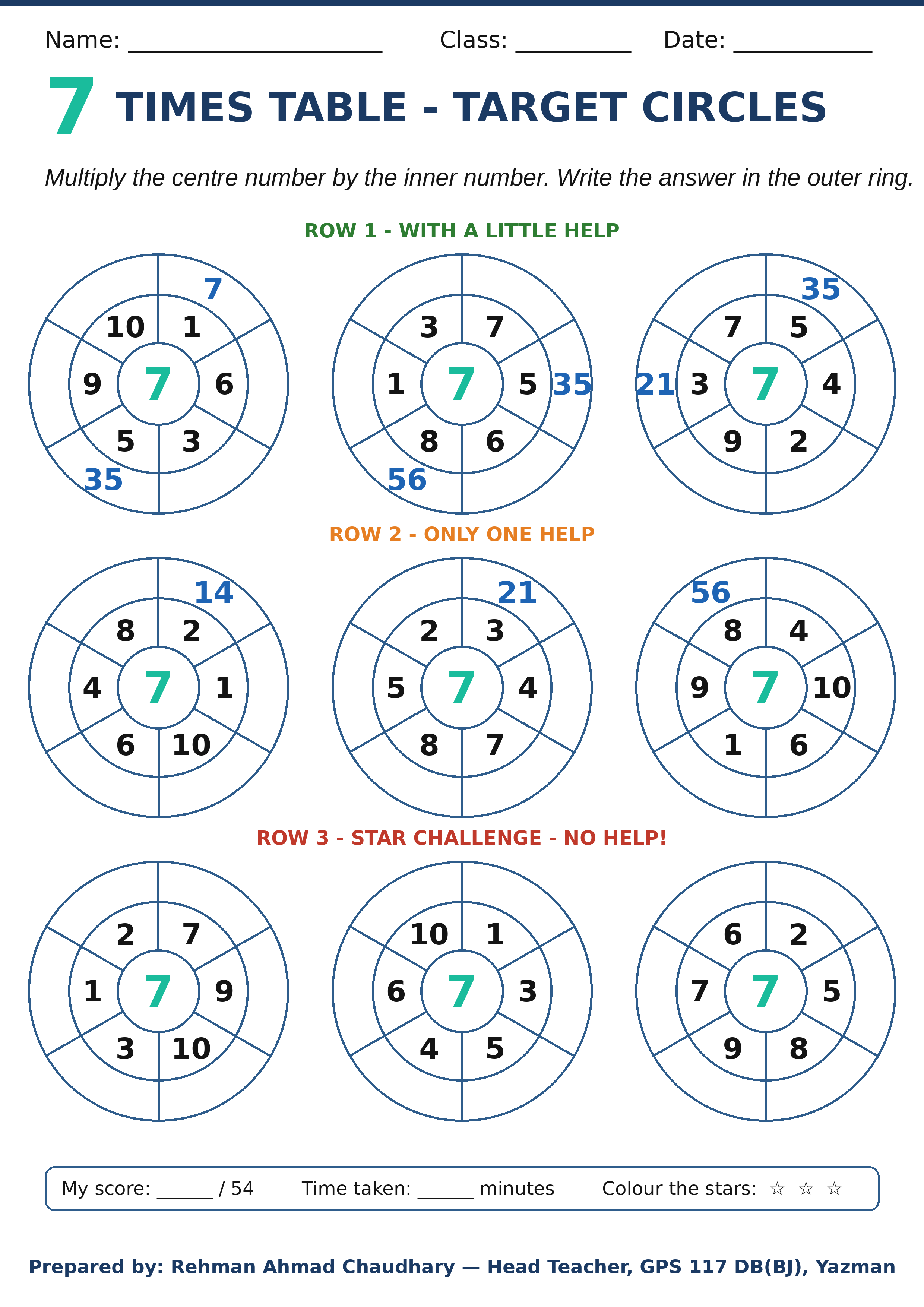
A target circle (also called a multiplication wheel) has three rings:
- The centre holds the table you are practising — for example, 7.
- The inner ring holds the numbers you multiply by — 1 to 10, in mixed order.
- The outer ring is empty. That is where the child writes each answer.
Multiply the centre number by the inner number, and write the product in the matching section of the outer ring. Simple to explain, quick to check, and — because the inner numbers are never in counting order — impossible to complete by chanting.
What makes these sheets different
54 questions per sheet, every fact repeated. Each page has 9 circles with 6 sections each. Across one sheet, every multiplier from 1 to 10 appears five or six times, so a child meets 7 × 8 again and again in different positions until it sticks.
Mixed order, always. The inner numbers are shuffled on every circle. There is no 1, 2, 3, 4 pattern to hide behind — the child has to recall each fact on its own.
Help that fades away. The three rows of circles give less and less support:
- Row 1 – With a little help: two answers are already printed in blue on each circle, so beginners start with confidence and can spot the pattern.
- Row 2 – Only one help: just one answer is given.
- Row 3 – Star Challenge: no help at all. This row is the real test, and children genuinely look forward to it.
A score strip at the bottom. Every sheet ends with My score: ___ / 54, the time taken, and three stars to colour in. Children compete against their own last score — not against each other.
Download the worksheets
One sheet per table, free to print for your classroom or home. Click a table to open its full-size image, or download everything in the two PDF packs below.
- 2 times table worksheet — printable image
- 3 times table worksheet — printable image
- 4 times table worksheet — printable image
- 5 times table worksheet — printable image
- 6 times table worksheet — printable image
- 7 times table worksheet — printable image
- 8 times table worksheet — printable image
- 9 times table worksheet — printable image
- 10 times table worksheet — printable image
PDF packs (A4, print-ready):
Here is what a finished sheet looks like — the 7 times table, usually the one children find hardest:
How to use them in class
- Start with one table, not all nine. Work through the tables in order, and do not move on until the Star Challenge row comes back mostly correct.
- Say it, then write it. For Row 1, ask the child to say each fact aloud (“7 times 8 is 56”) before writing. The voice builds the memory; the writing confirms it.
- Five to ten focused minutes beat one long session. One sheet a day, or even one row a day for younger children, repeated across the week, works far better than a single long drill.
- Let them mark with the answer key. Checking their own work against the key is part of the learning — children hunt for their mistakes with surprising honesty.
- Repeat the same table after a gap. Do the 7 sheet on Monday, other work on Tuesday and Wednesday, then the 7 sheet again on Thursday. The gap is what turns practice into long-term memory.
Ways to make it more fun
- Pair race: two children share one sheet — one takes the left half of each circle, the other the right. First pair to finish correctly wins.
- Beat your own time: use the time line on the score strip. A child who took 9 minutes last week and 6 minutes this week can see the progress.
- Colour reward: a fully correct circle earns colouring — children love decorating the wheels they have conquered.
- Class progress chart: nine tables make a natural journey. Put a chart on the wall and add a flag or star for each table a child masters. By the time the chart is full, the whole class owns all nine tables.
Printing tips
- The sheets are A4 and print cleanly in black and white — the design uses colour only for the given answers and headings, and everything stays readable on a basic school photocopier.
- For repeated use, slip a sheet into a plastic sleeve or laminate it. Children write with a whiteboard marker, wipe it clean, and the same sheet serves the next group.
- The individual images are high-resolution, so a single circle can also be enlarged and printed as a wall chart or projected for whole-class practice.
Who are these worksheets for?
They suit children roughly ages 7 to 11 (Grades 2–5) who are learning or still shaky on their multiplication tables — in school, at home, or in homeschooling. If a child can already recite a table but freezes on single questions, these sheets are exactly the bridge they need.
Looking for more free study material? My Punjab textbooks library offers complete school textbooks with online reading, and my series The Head Teacher’s Diary shares the real classroom stories behind resources like this one.
Frequently asked questions
Why is there no 1 times table sheet?
The 1 table is just counting — every answer is the number itself. The first table that needs real learning is 2, so this set covers the nine tables from 2 to 10.
Are the answer keys included?
Yes. The answer-keys PDF above has every sheet fully completed, one page per table, so a teacher or parent can check a finished sheet in seconds — or a child can self-check.
How many questions does a child answer in total?
54 per sheet, and 486 across the full set of nine tables — with every fact from 1 × to 10 × for each table repeated five or six times per sheet.
Can I use these in my classroom or share them with other teachers?
Yes — they are free for classroom and home use. Please keep the credit line at the bottom of each sheet, so other teachers can find the source.
My students know the table in order but not mixed up. Will this help?
That is precisely what these sheets are designed for. The mixed order removes the chanting shortcut, and the fading help rows let a struggling child build up to the no-help Star Challenge instead of facing it on the first try.
How often should a child practise?
Short and regular wins: 5–10 minutes a day on one table, revisited after gaps of a few days, until the Star Challenge row is fast and correct. Then move to the next table — and keep revisiting the old ones once a week.
Prepared by Rehman Ahmad Chaudhary — Head Teacher, GPS 117 DB(BJ), Yazman, Pakistan. I teach in a government primary school and share the resources I make for my own classroom, free for teachers everywhere.