· Rehman Ahmad · 9 min read
How to Help Your Child Learn Times Tables (Without the Tears)
A head teacher's calm guide for parents: the right order to learn the tables, a five-minute daily method that actually sticks, the tricks that work, and what to stop doing at homework time.

How to Help Your Child Learn Times Tables (Without the Tears)
If times tables homework ends in tears in your house, hear this from a head teacher: you are not alone, and it is almost certainly not your child’s fault.
I meet the same story every year. A bright child freezes over 7 × 8, guesses, gets it wrong, and soon decides they are “bad at maths”. They are not. The problem is usually one of two things: the tables were taught in the wrong order, or home practice carries too much pressure.
Children learn while they feel safe, succeed often, and stop before they are tired. This is the method I give parents at my school when they ask how to help your child learn times tables at home: no shouting, no long sessions, no tears.
Why tables matter (briefly, and without fear)
Times tables are the key that unlocks what comes next. Division is tables read backwards. Fractions need them constantly — seeing that 4/8 is the same as 1/2 is a tables skill. A child who knows them has spare attention for the real problem, instead of spending it all on one small sum inside it. A practical skill, built slowly — not a test of worth.
Learn them in the right order
Here is the biggest mistake I see: tables learned in counting order — 2, 3, 4, 5, up to 10 — as if all tables were equal. Some are friendly, some have tricks, two are genuinely hard. How to learn times tables without the struggle is mostly about meeting them in this order:
- First: 2, 5 and 10. The 2s are just doubling, the 5s follow the clock face and end in 5 or 0, the 10s are adding a zero. Three quick wins.
- Next: 3 and 4. Threes come by slow counting. Fours are only doubling twice — 4 × 7 is double 7 (14), doubled again (28).
- Then: 6 and 9. Sixes are double the threes your child already knows. Nines have the finger trick below — the most enjoyable table of all.
- Last: 7 and 8. By now most facts were already met in earlier tables — 7 × 3 came with the threes — so only a handful are new. Eights fall to repeated doubling.
Every new table holds less new work than the one before. The hard tables shrink before your child even starts them.
This order, plus a star chart to track it, is in a free chart you can print for the fridge:
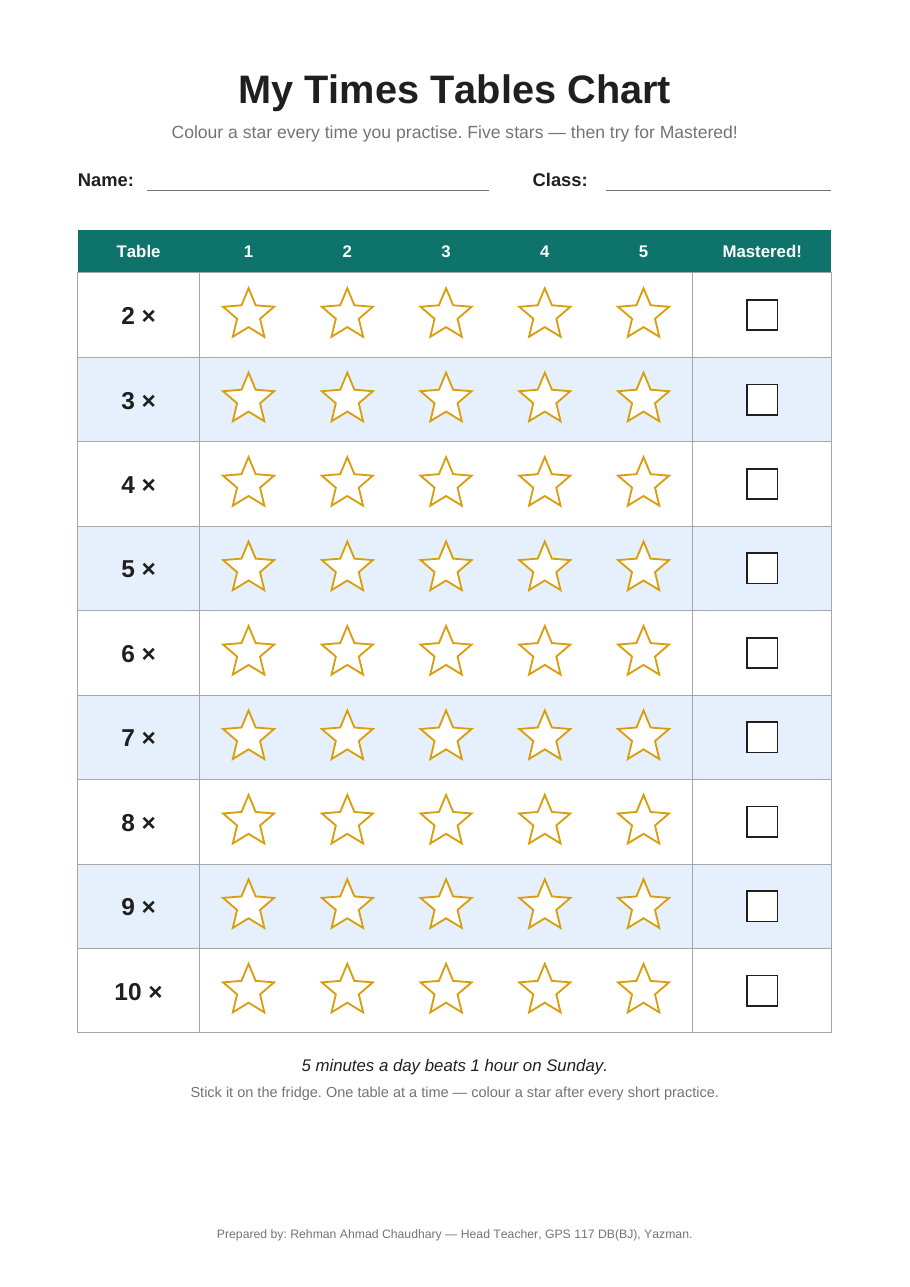
Page 1 is the chart: one row per table, five stars to colour per practice, a “Mastered!” box to tick. Page 2 explains this order for parents, tricks included. Its bottom line is true: five minutes a day beats one hour on Sunday.
The five-minute daily method
Short and daily beats long and weekly. The routine:
- One table at a time. Stay on one table until it is secure. Do not juggle three in a week.
- Chant it together, once or twice. Out loud, anywhere relaxed. This is the warm-up, not the test.
- Quick-fire, mixed up. Ask single facts out of order: “What is 4 × 6? And 4 × 9?” Mixed order turns chanting into real knowledge, because real questions arrive in any order.
- One short written round. A few sums on paper, or one wheel of written practice (below). Writing fixes facts in a way saying alone does not.
- Colour a star, and stop while winning. Stopping on a success is deliberate — tables end well, and tomorrow starts willingly.
When all five stars are coloured and quick-fire answers come calmly, tick “Mastered!” together and make a small fuss. Then move on, revisiting old tables briefly once a week.
Tricks that actually work
Four tricks have survived years in my classroom:
Skip-counting songs. Counting in 3s, 4s or 5s to any tune your child likes builds the sequence under the facts. Not the whole job — but the friendliest way in.
The 9s finger trick. Hold up ten fingers. For 9 × 4, fold down the fourth finger. Fingers left are the tens (3), fingers right are the ones (6): the answer is 36. It works up to 9 × 10, and feels like magic.
Doubles for 4s and 8s. The 4 table is double-double: 4 × 7 → double 7 is 14, double 14 is 28. The 8 table adds one step: 8 × 6 → 12, 24, 48. A child who can double already owns both tables.
Swap it. 3 × 4 and 4 × 3 are the same fact in different clothes. Once a child believes this, the facts to learn nearly halve — a fact from the 3s is quietly learned for the 4s, 6s and beyond.
You will see promises to learn times tables fast all over the internet. Honestly, there is no shortcut — but the right order, daily practice, and these tricks are as close to fast as real learning gets. Most children secure all the tables within a school term this way.
Free practice I made for my own classroom
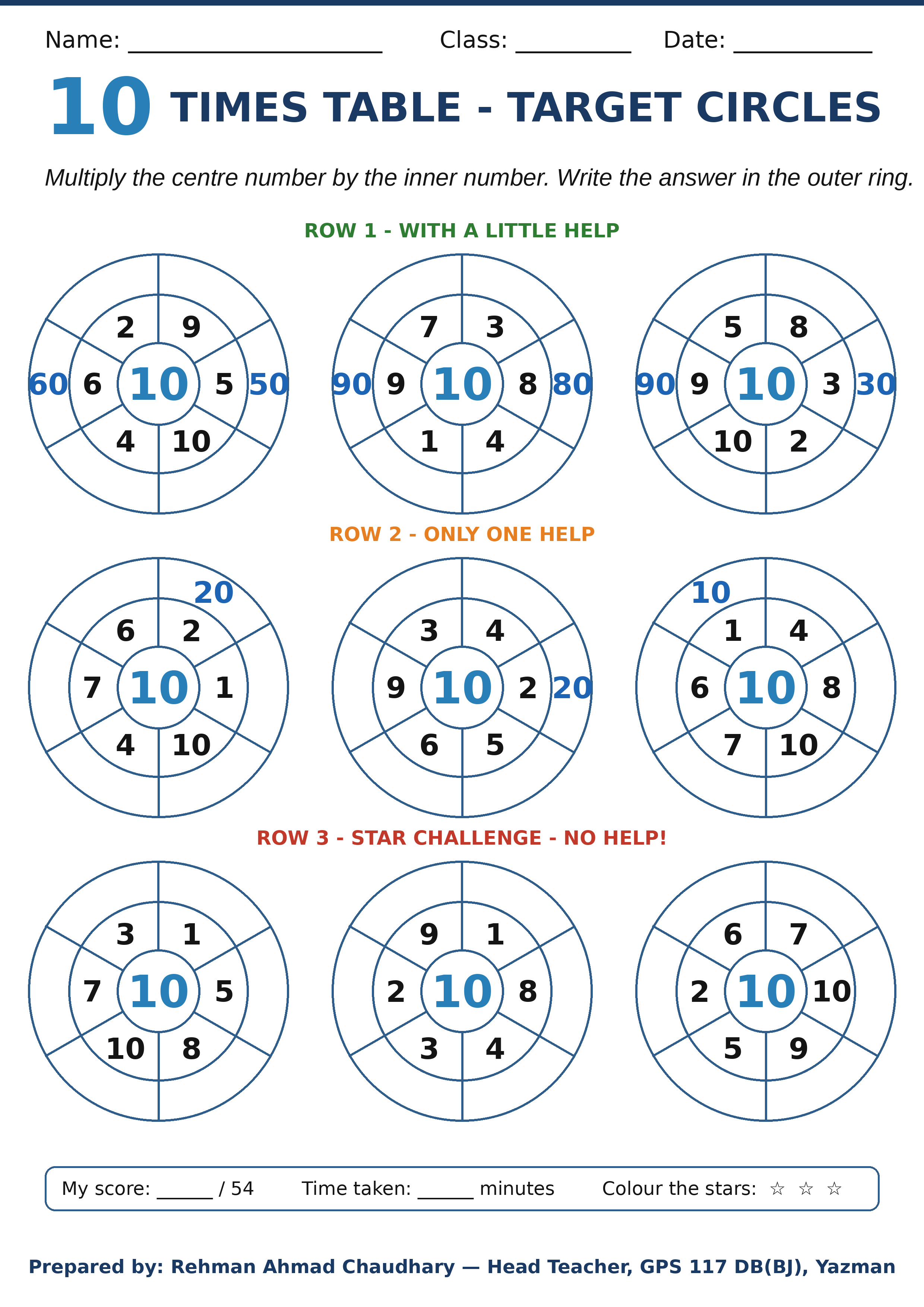
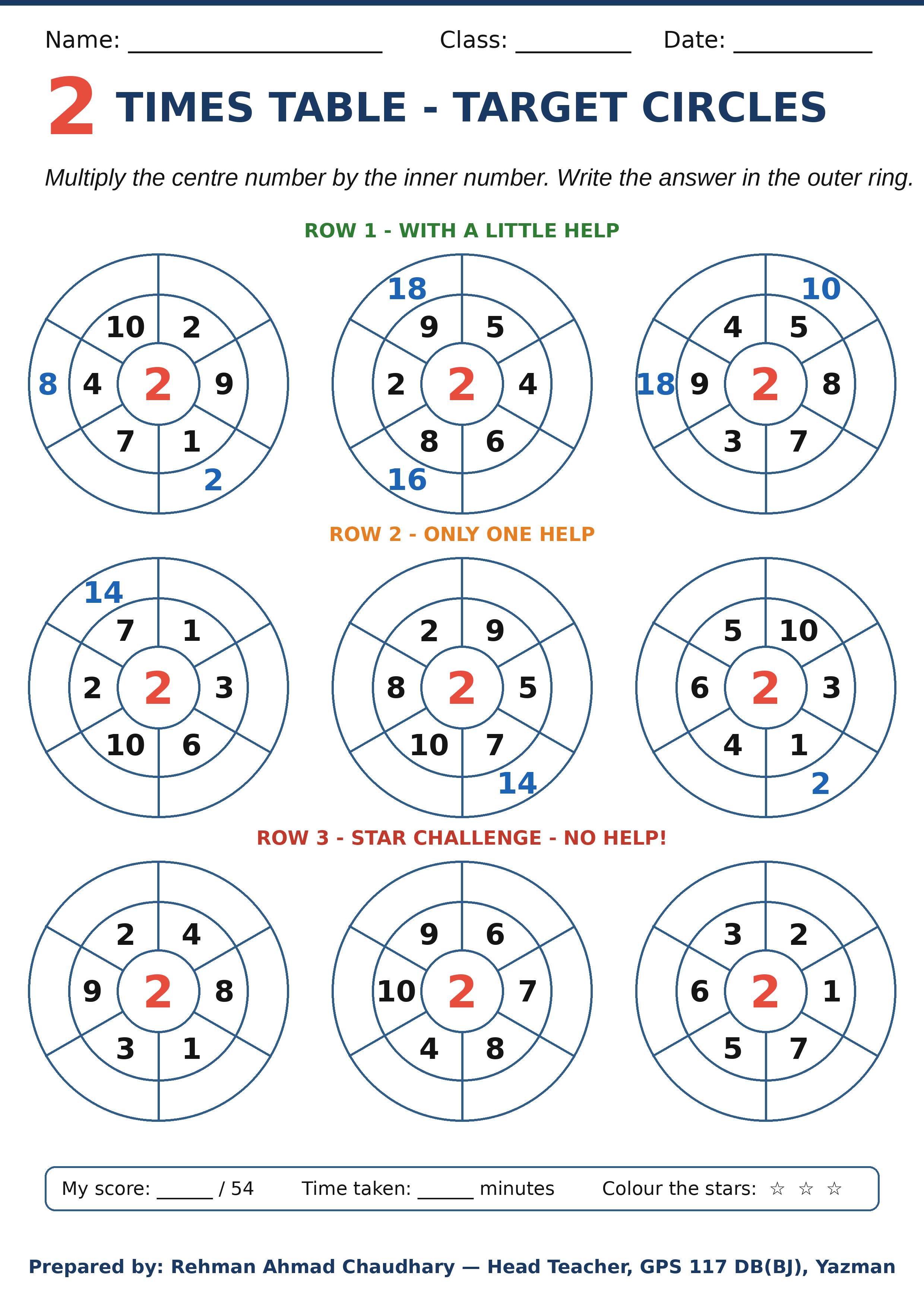
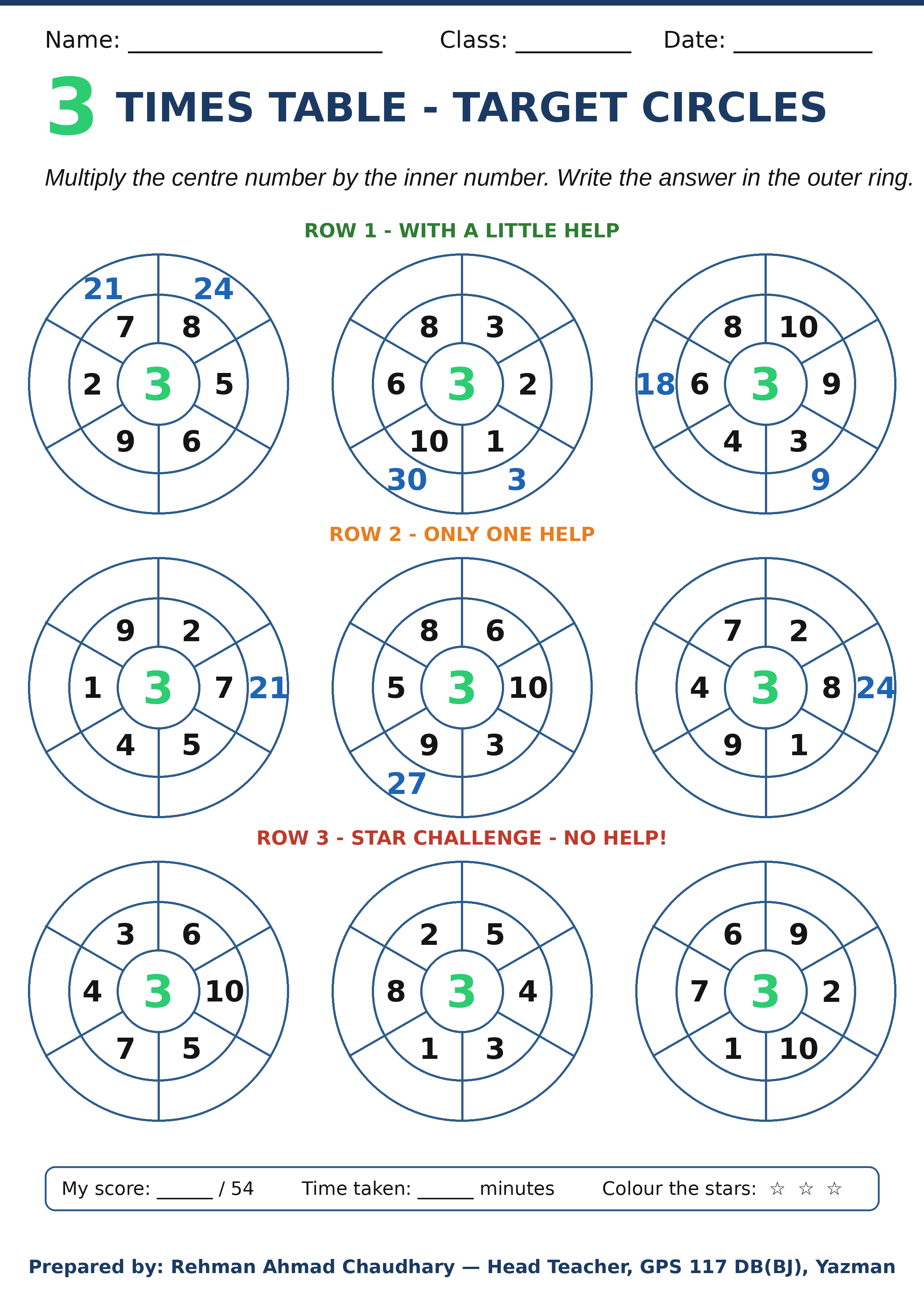
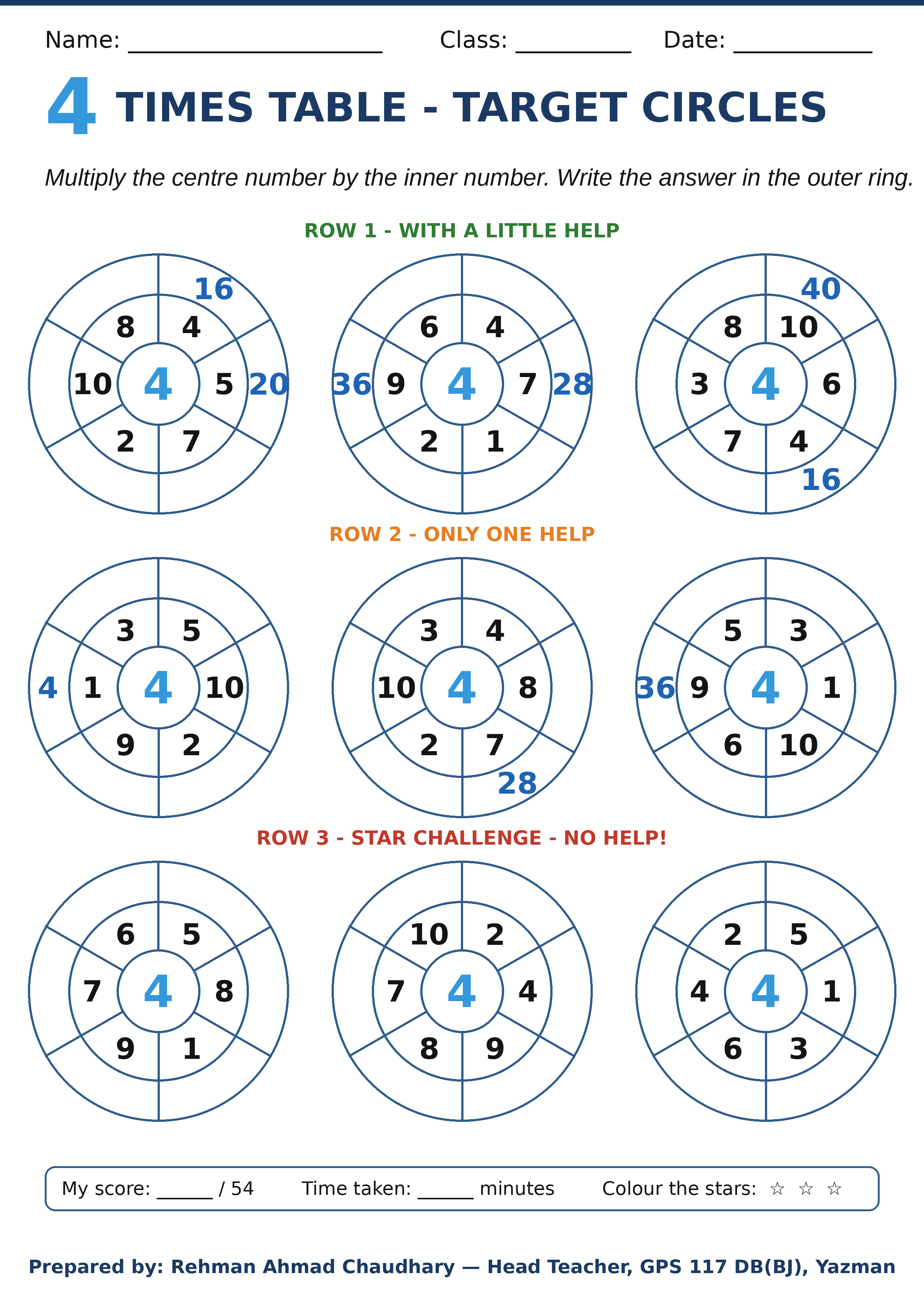
Talking and chanting need a partner activity, and this is mine. My times table target circles worksheets are free printable wheels for tables 2 to 10: the table sits in the centre, the numbers to multiply by are shuffled around it, and your child writes answers in the outer ring. Mixed order means chanting cannot cheat — each fact must be known on its own. Each page holds 54 questions, and the printed help fades row by row until the last row, the Star Challenge, gives none.
A free online game on the same page offers the same wheels on screen: pick a table, type each answer into the wheel, get an instant tick or cross, a score out of 54 and stars at the end. Use paper first; let the game be the reward.
When tables are firm, the next step is division — only the tables walked backwards. My division worksheets with target wheels use the identical format, with full answer keys.
What NOT to do
A short list, from watching well-meaning parents get this wrong:
- Do not time a frightened child. Timed tests belong much later, when facts are secure and a child enjoys racing their own record. A stopwatch over an unsure child teaches one lesson: maths is danger.
- Do not compare. Not with siblings, cousins, or the neighbour’s child who “knew them all by six”. Comparison shames, and shame switches learning off.
- Do not cram all the tables together. Ten at once is overload, not ambition. One table, five stars, then the next — the slow-looking road is the fast one.
- Do not make practice a punishment. Tables tied to bad behaviour or withheld treats turn five minutes into a daily conflict.
- Do not show your frustration. Children read faces faster than words. If a session goes badly, end it kindly and try tomorrow.
Frequently asked questions
At what age should children learn times tables?
Most children start with the 2, 5 and 10 tables around ages 6 to 7, and work towards all tables by about age 9 or 10. Treat these as weather, not law: a child who masters them at ten, confident, is better placed than one drilled into hating them at eight.
How long does it take to learn all tables?
With five minutes of daily practice in the right order, most children secure one table every one to two weeks — a full set in roughly one school term. Irregular practice stretches this far more than ability does. The chart makes the habit visible: five stars per table.
My child keeps forgetting — is that normal?
Completely normal. Forgetting and re-meeting a fact is not failure; it is how memory builds. A fact recalled after a gap sticks better than one repeated ten times in a sitting. Hence the weekly revisit of finished tables — brief returns move facts into long-term memory.
Should I use an app or paper first?
Paper first, screen as the reward. Writing by hand slows the fact down just enough to think, and a fridge chart keeps progress visible. Games — including the free wheel game on this site — are excellent for extra rounds, and instant ticks genuinely motivate. But screen-only practice often makes children fast at tapping and slow at knowing.
What if my child hates maths?
Start smaller than small: only the 2 table, only doubling, as a game about pairs of socks and shoes — and end every session on a success, even a planned one. Hate of maths is almost always hate of failure, not of numbers. Three weeks of tiny daily wins usually changes a child’s mind about the subject — and about themselves. If distress spreads to all schoolwork, tell their teacher early.
You have got this — and so have they
Take one idea from this page: times tables practice at home does not need to be long, loud or tearful. The right order, five calm minutes a day, a star on the fridge chart, and tricks that turn hard tables into easy ones — that is the whole system my own pupils use.
Start tonight with the friendly three and the free chart and target circles worksheets. When division arrives, the division target wheels wait in the same format, and after that, fractions worksheets for Grades 4–5 show what tables unlock next. For free software for the school computer, I look through FileCobra, where I keep the programs I actually use.
These are times tables for kids who learn like real children: small steps, the right order, wins along the way.
Written by Rehman Ahmad Chaudhary — Head Teacher, GPS 117 DB(BJ), Yazman, Pakistan. I build these resources for my own classroom first and share them free for teachers everywhere.