· Rehman Ahmad · 8 min read
Fractions Worksheets for Grades 4–5 (with Answers, Free Printable)
Free printable fractions worksheets for Grades 4 and 5, built pictures-first by a head teacher: shading, equivalent fractions, comparing, adding, simplifying and converting — with a full answer key.

Fractions Worksheets for Grades 4–5 (with Answers, Free Printable)
Every year I watch the same thing happen. A child who was confident with numbers all through Grade 3 meets fractions in Grade 4, and within a fortnight the confidence is gone. Shoulders drop. The pencil slows down. Maths becomes “the hard subject.”
It is rarely the child’s fault. Fractions are usually the first topic where we hand children symbols before pictures. We write 3/4 on the board, explain the top number and the bottom number, and move on — but the child has never seen three quarters of anything. The symbol has nothing to attach to in their mind, so it floats away by the next lesson.
These fractions worksheets were built to fix that order. Pictures first, symbols second, and rules only after the child can see why the rule works. The pack is free, it prints in black and white, and it ends with a complete answer key so children can check their own work.
Download the pack:
Pictures first: the only rule that matters
Before any page in this pack, a child should have held a fraction in their hands. In my classroom that means three cheap activities, none of which needs a printer.
Fold paper. One sheet folded in half, then in quarters, then in eighths. The child unfolds it, counts the parts, and shades some with a crayon. Halves, quarters and eighths stop being vocabulary and become something their fingers remember.
Cut the roti or the apple. At home this is even easier. One roti shared between two children is a half each. Shared between four, a quarter each — and a quarter looks smaller than a half, which is the single most important sight in all of fractions. An apple cut on the kitchen table teaches what three lessons of symbols cannot.
Draw before you write. Every page of the pack returns to drawing: shade this, mark it on the line, look at the two shapes and say which is bigger. Only when a child can draw a fraction do I ask them to calculate with one.
What is inside the pack
This is a set of fractions worksheets with answers — six working pages and a two-page answer key in one PDF.
Page 1 — What is a fraction? A gentle cover page: a shaded circle and a shaded bar, the words numerator and denominator explained in two lines, and how to use the pack. Do this page together, adult and child, before anything else.
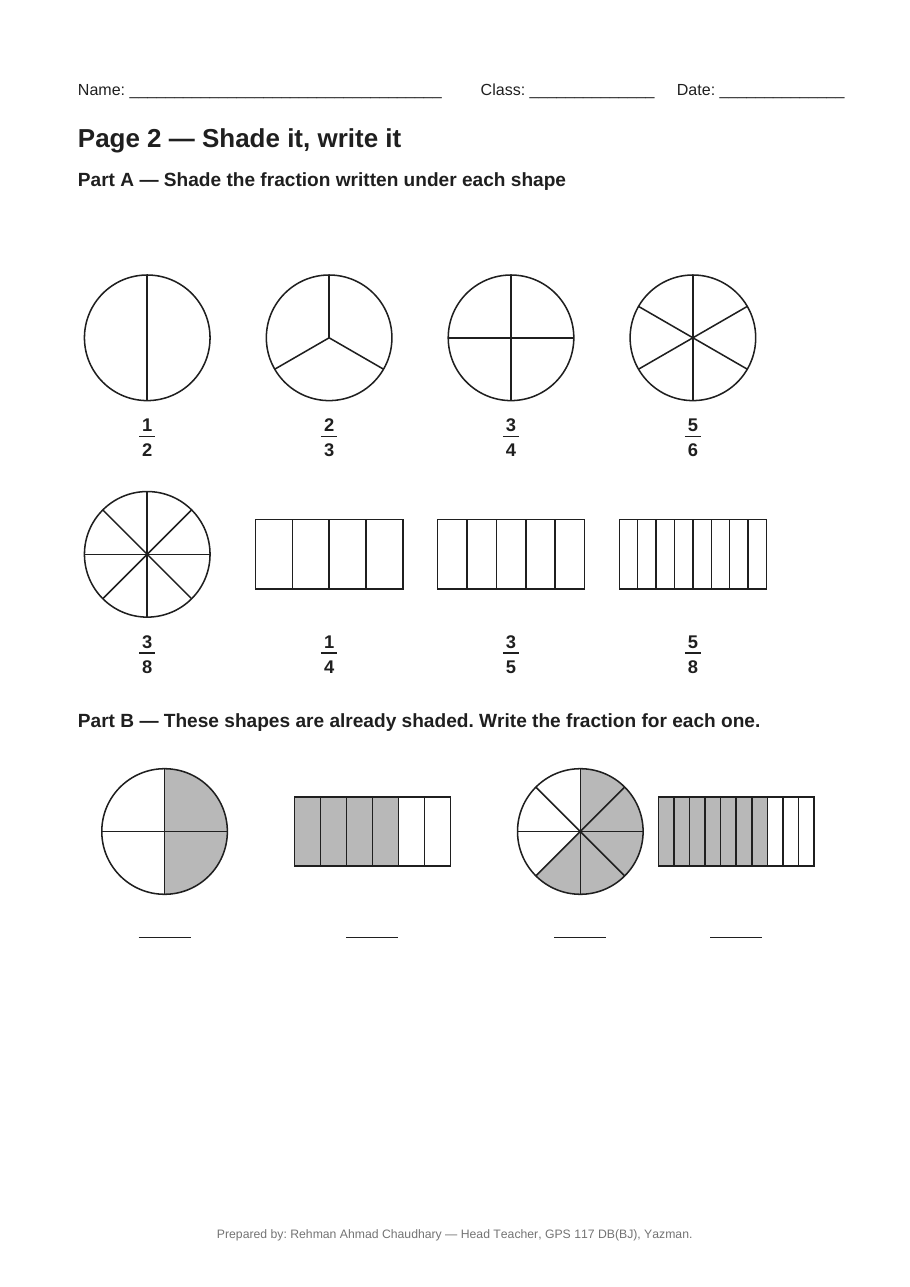
Page 2 — Shade it, write it. Eight shapes to shade (halves, thirds, quarters, sixths, eighths — circles and bars), then four shapes already shaded where the child writes the fraction. This page is the heart of the pack: it connects the picture to the symbol in both directions.
Page 3 — Equivalent fractions. Ten questions — fill the missing number (1/2 = ?/4, 2/3 = ?/9), then write two equivalents of your own — plus number lines where the child marks 1/2, 1/4, 3/4, 1/3 and 2/3. The number line matters: it shows fractions as amounts on a road between 0 and 1, not just parts of a pizza.
Page 4 — Comparing fractions. Ten pairs with a box for <, > or =, mixing the three cases children must learn to spot: same denominator, same numerator, and the benchmark of one half (is it more or less than 1/2?). Three ordering sets follow.
Page 5 — Add and subtract, same denominator. Ten questions plus two mixed review items. One of the answers comes to exactly 1, and one comes to 0 — children who expect trick answers stay awake.
Page 6 — Simplify and convert. Ten fractions to reduce to lowest terms (4/8, 6/9, 10/15 and friends), then six conversions: improper fractions to mixed numbers (7/4 = 1 3/4) and back again.
As fraction worksheets for grade 4, pages 1 to 4 are the core. As fraction worksheets for grade 5, pages 5 and 6 carry the load. One pack, two years of children — print the pages your class is ready for.
How I sequence it in class over two weeks
- Days 1–2: Folding and cutting activities only. No worksheets. By the end of day 2 every child has shaded halves, quarters and eighths with their own hands.
- Days 3–4: Pages 1 and 2. Slowly, with the answer key face down until the page is finished.
- Days 5–6: Page 3, equivalent fractions. I put 1/2, 2/4 and 3/6 of a roti on the desk at the same time — same amount of bread, three different names. Children argue about it, and the arguing is the learning.
- Days 7–8: Page 4, comparing. Benchmark halves first (“is it bigger than half a roti?”), symbols second.
- Days 9–10: Pages 5 and 6, one per day, and the children mark their own work from the key. Self-marking is not laziness on my part — a child who finds their own mistake remembers the fix.
The three mistakes I see every year
Adding the denominators. Given 2/5 + 1/5, half the class will write 3/10 in the first week. It is a sensible-looking error: two numbers on top added, two numbers below added. The pack attacks it on page 1 and again on page 5 — if you add two slices of a five-slice roti, the roti did not grow to ten slices. The size of the parts never changes; only the count does.
Thinking 1/4 is bigger than 1/2 because 4 is bigger than 2. This is whole-number thinking applied where it does not belong, and every child does it. Page 4 forces the comparison again and again, and the roti test settles it at home: would you rather have 1/2 of the roti or 1/4? Nobody chooses the quarter twice.
Forgetting to simplify. A correct answer left as 8/10 instead of 4/5 is unfinished work, like a sentence without a full stop. Page 6 drills reducing until it becomes a habit, and the answer key shows the simplified form with the unsimplified one noted beside it, so children see both steps.
Frequently asked questions
Are answers included?
Yes. These are fractions worksheets with answers — the full key sits on the last two pages of the same PDF, in the same order as the questions, so a child or parent can check a page in a minute without hunting through a separate file.
Which grades is this for?
Grades 4 and 5 (roughly ages 9–11). Strong Grade 3 children can start pages 1 and 2, and Grade 6 children who are shaky on fractions benefit from the full pack as revision — the pictures-first approach fills gaps that symbol drilling missed the first time round.
Should my child master times tables first?
It helps, but do not wait for perfect tables. Equivalent fractions and simplifying both lean on multiplication facts (seeing that 4/8 is made by doubling 2/4), so I run both side by side: fractions in the maths lesson, and ten minutes of table practice with my times table target circles on other days. Each one quietly strengthens the other.
How do I teach equivalent fractions at home?
With food and paper, not explanations. Fold one strip of paper into halves and another into quarters; shade one half of the first and two quarters of the second, lay them side by side, and let your child say what they notice. Then do the same with sixths. Page 3 of the pack follows exactly this path on paper.
Can I print this for my whole class?
Yes — that is what it is for. Print as many copies as your class needs, as often as you need them. The pack is free for classroom and home use. If division comes next in your scheme of work, my division target wheels worksheets follow the same pictures-first, answers-included pattern.
Print one page tonight
Fractions do not have to be where confidence goes to die. Start with page 2, a pencil and ten quiet minutes; let your child shade, write and check their own work. Then keep the roti test in your pocket for the rest of the topic.
Like all my classroom resources, these free printable fraction worksheets are ones I use with my own pupils first. And when I need free software for the school computer — a PDF tool, a screen recorder, a typing tutor — I look through FileCobra, where I keep the programs I actually use, free to download.
Written by Rehman Ahmad Chaudhary — Head Teacher, GPS 117 DB(BJ), Yazman, Pakistan. I build these resources for my own classroom first and share them free for teachers everywhere.
