· 9 min read
Building a Practice Question Bank for Students: What 15,000 Questions Taught Me About Real Assessment
A head teacher's guide to building a practice question bank for students - QuizNama's 15,227 Class 3-8 questions, and how any teacher can start their own.
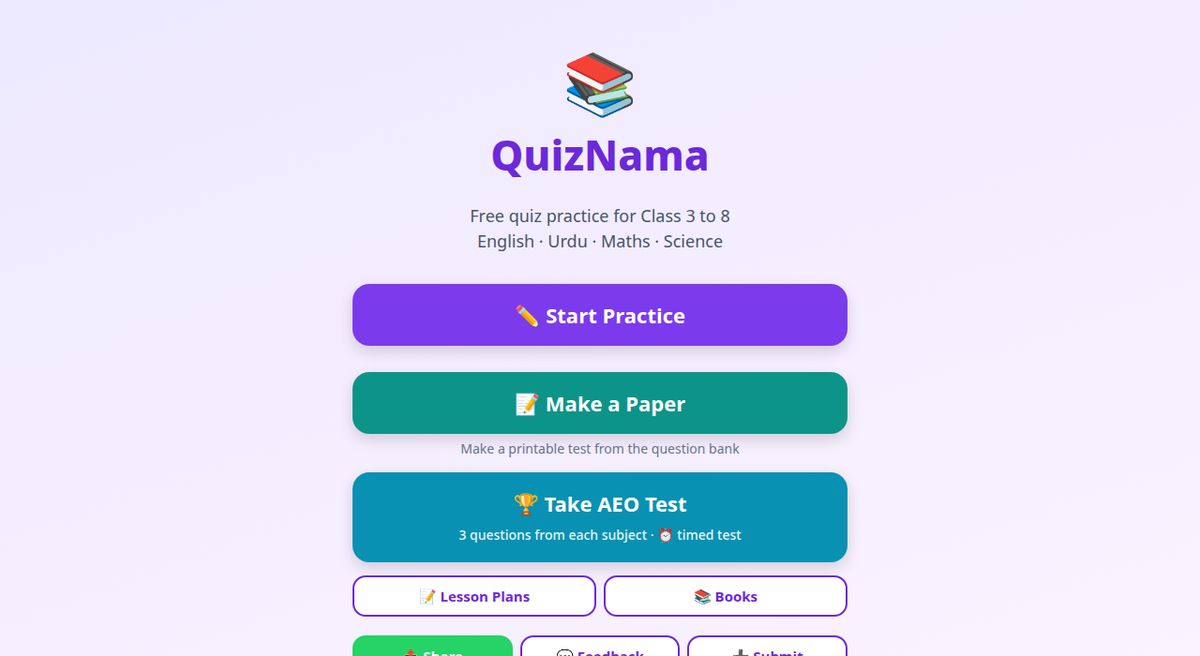
A practice question bank for students is only useful if a teacher can find the right question fast. I learned that slowly. I am a head teacher at a government primary school in Yazman, Punjab, and I built QuizNama, a free Class 3–8 app that now holds 15,227 questions in English, Urdu, Maths and Science — live at rehmanahmad.com/sawalnama, offline, no sign-up, no ads. QuizNama was formerly SawalNama, which is why the web address still says sawalnama.
Key Takeaways
- A question bank is a finding system first: if a teacher cannot pull ten questions on one SLO in a minute, it is a pile.
- Tag every question by class, subject, topic, SLO and difficulty as you write.
- Practice and test modes differ: untimed practice builds understanding, a short test builds exam readiness.
- Start from the official textbook and the SLO list, not an app idea — the curriculum is the specification.
- A bank stays alive only if teachers can report a wrong question in one tap.
In this article
- What a question bank is
- Why I started with the textbook
- How I organised 15,227 questions
- Practice vs test mode
- Mistakes that cost me time
- Start your own bank
- FAQ
- The bank is never finished
What a Practice Question Bank for Students Actually Is
An item bank is simply a library of assessment questions. Instead of starting from scratch every time you build a quiz, you draw from items already created, organised, and tagged by topic or standard — that is how TAO Testing describes free item banks (TAO Testing, retrieved 2026-11-20).
The important word is organised. A folder of 15,000 questions in one long list is not a bank. A bank answers three questions about every item: which class, which topic and SLO, and how hard? With those answers, a teacher builds a ten-question fractions set for Class 5 in a minute. Without them, the teacher scrolls, guesses, gives up — and the bank dies unused.
Why I Started With the Textbook, Not the Technology
The first decision saved the project: the Punjab textbook is the specification, the SLO list the index. Every question is written against the official Class 3 to 8 textbooks — the same free books in the Punjab textbooks library — and organised by Student Learning Outcome, the small testable skill each chapter teaches.
Starting from the textbook did three things no app could. First, it settled what to include: if it is in the book, it belongs in the bank. Second, it gave every question a natural home — class, subject, chapter, SLO — so tagging designed itself. Third, it made the bank defensible in a staffroom.
The big free banks work the same way. Problem-Attic, one of the largest, holds more than 320,000 released questions, and teachers search it by subject, grade or standard to pull items into a custom assessment (TAO Testing, retrieved 2026-11-20). The questions are the raw material; the search is the product. Most small projects get this backwards — collect first, organise never. Exam boards build the same way: AQA’s Exampro lets teachers filter by topic, skill and level of demand to build quick starters and bespoke tests (AQA, retrieved 2026-11-20).
How I Organised 15,227 Questions So a Teacher Can Find One in Seconds
QuizNama’s bank is arranged the way a teacher thinks: class, subject, topic, level. Each question carries its SLO tag, so a teacher can practise one outcome — say, Class 3 English SLOs — instead of a whole chapter. AEO tests are built SLO by SLO, so a bank that cannot filter by SLO cannot prepare a child.
Three design choices keep the bank usable at this size:
Levels, not just topics. Every question is Easy, Medium or Hard, so a teacher can give the easy set to the struggling child and the hard set to the early finisher. Without levels, a bank serves only the average child — who does not exist.
What a Bank Entry Actually Looks Like
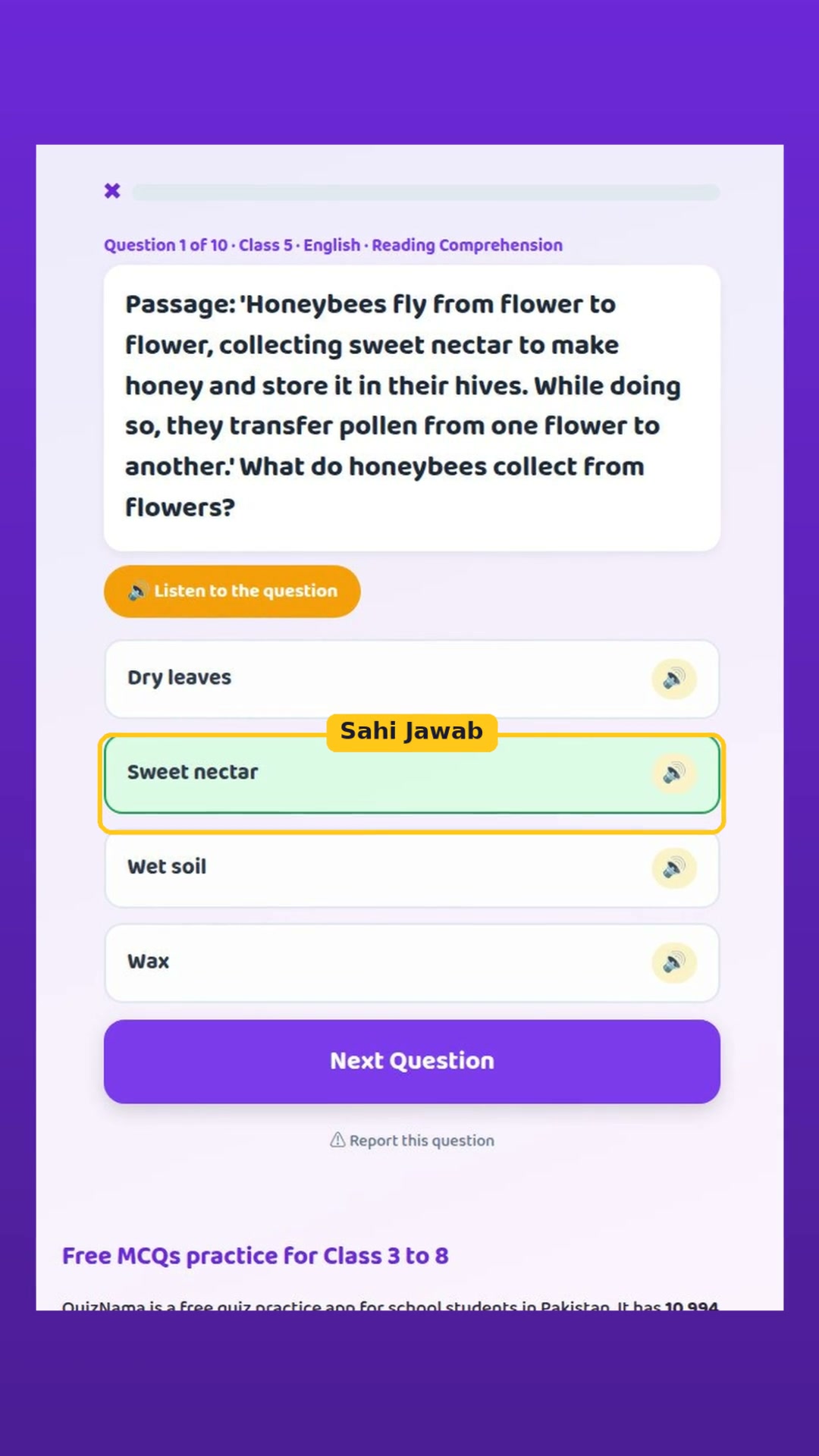
Every entry shows its tags on screen — “Question 1 of 10 · Class 5 · Maths · Fractions”. Two more real examples:
- English · Mixed Practice: “Plural of ‘Focus’ is:” — Foci / Focuse / Focusen / Focuss.
- English · Grammar — Fill in the Blank: “‘She is ______ punctual student.’” — the / any / an / a.
One-page cheat sheets beside the questions. The bank carries 125 cheat sheets — one page per topic with the definitions and rules a child needs. Without one, the child goes back to the textbook every third question.
Paper generation built in. Make a Paper mode: choose class, subject and topics, set the question count and difficulty, add the school name and test title, and the app produces a paper you can save as PDF or share on WhatsApp. A bank that only works on a phone screen stops at the classroom door — many colleagues still teach from paper.
Tagging is the bottleneck: questions were written faster than they could be tagged, and the untagged tail is the least-used part of the app. Tag as you write — tagging later is a second project.
Practice Mode and Test Mode Do Two Different Jobs
The most common mistake in classroom quiz apps is treating practice and testing as the same activity with a different timer. They are not. QuizNama runs them as two separate modes because they train two different things.
Practice mode is untimed, topic by topic, with instant feedback. A child answers, sees at once whether it was right, and can retry only the wrong ones — practise what you failed, not the twenty you knew. Every question can be read aloud, and the app works offline after the first load.
Test mode is the opposite discipline. The AEO Test is a short timed test — three questions from each subject, nine for Classes 3 to 5 and twelve for Classes 6 to 8, at 40 seconds per question — in the style of AEO tests. At the end, students see their result and retry only the wrong ones. The point is not the score: it is meeting a clock, a mixed paper and a result screen before the real test day, when the novelty itself costs marks.
| Practice mode | Test mode | |
|---|---|---|
| Timer | None — take your time | 40 seconds per question |
| Questions | One topic or SLO at a time | Mixed subjects, 9 or 12 questions |
| Feedback | Instant, retry only wrong ones | Result at the end, then retry wrong ones |
| Goal | Understanding | Exam readiness |
Teachers get the third view: student names saved on the device, practice history, one-tap WhatsApp sharing. When a question is wrong — it happens — one tap on “Report this question” sends it to us.
The Mistakes That Cost Me the Most Time
A build like this teaches mostly through its failures:
I collected before I tagged. The first few thousand questions went in with class and subject only, and adding SLO and difficulty tags afterwards meant re-reading questions I had already written. Tag as you write, or do not write at all.
I assumed internet. The first version leaned on being online — until I watched a child wait for a question on a connection that drops every ten minutes. I rebuilt the app offline-first: in a rural school, offline is not a feature, it is the requirement.
I trusted my own answer key. A bank’s credibility is its answer key, and mine had errors in the early chapters. The fix was not more careful typing; it was the one-tap report button: send me the wrong ones and I fix them. A bank with a visible correction path earns more trust than one claiming to be error-free.
How to Start Your Own Practice Question Bank for Students
You do not need 15,000 questions — one chapter, done properly:
- Pick one class and one subject — Class 5 Maths, for example. One subject done well beats four thin ones.
- Copy the SLO list for one chapter. Each outcome becomes one practice set — the ready-made lesson plans already list them chapter by chapter.
- Write 10 questions per SLO: 4 easy, 4 medium, 2 hard. Write the answer key in the same sitting and have a colleague check it.
- Tag as you write: class, subject, chapter, SLO, level. A spreadsheet is enough — one row per question, one column per tag.
- Add a one-page cheat sheet per chapter — definitions and worked examples only.
- Test it on paper first. Print ten questions, give them to one class, watch where children stall.
- Add the feedback loop before you add more questions: one channel — a WhatsApp number, a staffroom notebook — where a teacher can report a wrong question in seconds. Without it, errors fossilise.
- Only then think about an app. A spreadsheet plus a printout serves a whole school.
QuizNama is free at rehmanahmad.com/sawalnama — Class 3 to 8, English, Urdu, Maths, Science, with the AEO timed test and paper generator. Use it, break it, report the wrong questions; that is how it got this far. And when you need a small classroom utility for your own computer, I grab mine from FileCobra — every download the verified free version, not a repackaged surprise.
Frequently Asked Questions
How many questions does a practice question bank need before it is useful?
Ten good questions on one SLO beat a thousand untagged ones. Start with one chapter.
What is an SLO, and why does it matter for a question bank?
SLO stands for Student Learning Outcome — one small, testable skill. AEO tests are built SLO by SLO, so a bank organised by SLO lets a teacher practise that skill. Punjab’s own system runs on them: the Punjab Education Foundation’s 2025–26 content book is organised week by week by SLO (PEF, retrieved 2026-11-20).
The Bank Is Never Finished
A practice question bank has no end date. Textbooks change, teachers report errors, children prove your clearest questions wrong. That is the work: every corrected question makes the next thousand practise something true.
Start with one chapter. Tag everything. Let teachers report errors. The bank you build will be smaller — and used more.
Sources
- TAO Testing, “The 3 Best Free Item Banks for Digital Assessment” — https://www.taotesting.com/blog/free-item-banks/ (retrieved 2026-11-20)
- AQA, “Using our assessment tools to plan and teach” — https://www.aqa.org.uk/resources/assess/using-our-assessment-tools (retrieved 2026-11-20)
- QuizNama live app — https://rehmanahmad.com/sawalnama/ (verified live 2026-11-20; 15,227 questions, Classes 3–8; AEO Test 9/12 questions at 40 seconds each; 125 cheat sheets per the live v3.52 bank)
- Punjab Education Foundation, “Content Book 2025–26” (week-wise SLO based) — https://www.pef.edu.pk/pdf/downloads/Content-List/Content-book-Middle-01-09-25.pdf (retrieved 2026-11-20)