Economics (EM) — Class 10 Punjab Board book
Official Punjab Curriculum and Textbook Board (PCTB) Economics textbook for Class 10 (English Medium). Neeche poori kitab online parhein ya official PDF download karein — bilkul muft.
Poori kitab yahin parhein
Economics (EM) — Class 10 — neeche scroll karte jayein, aglay safhay khud aa jayein ge. Zoom bhi kar sakte hain.
Internet darkar hai — kitab official PECTAA file se load hogi
Chapter Quiz
Kitab load hote waqt waqt guzarein — Economics (EM) ke asbaaq par 5 sawal!
📚
Kitne chapter yaad hain aap ko?
1 / 5
🎉
0 / 5 durust!
Is kitab ke baare mein
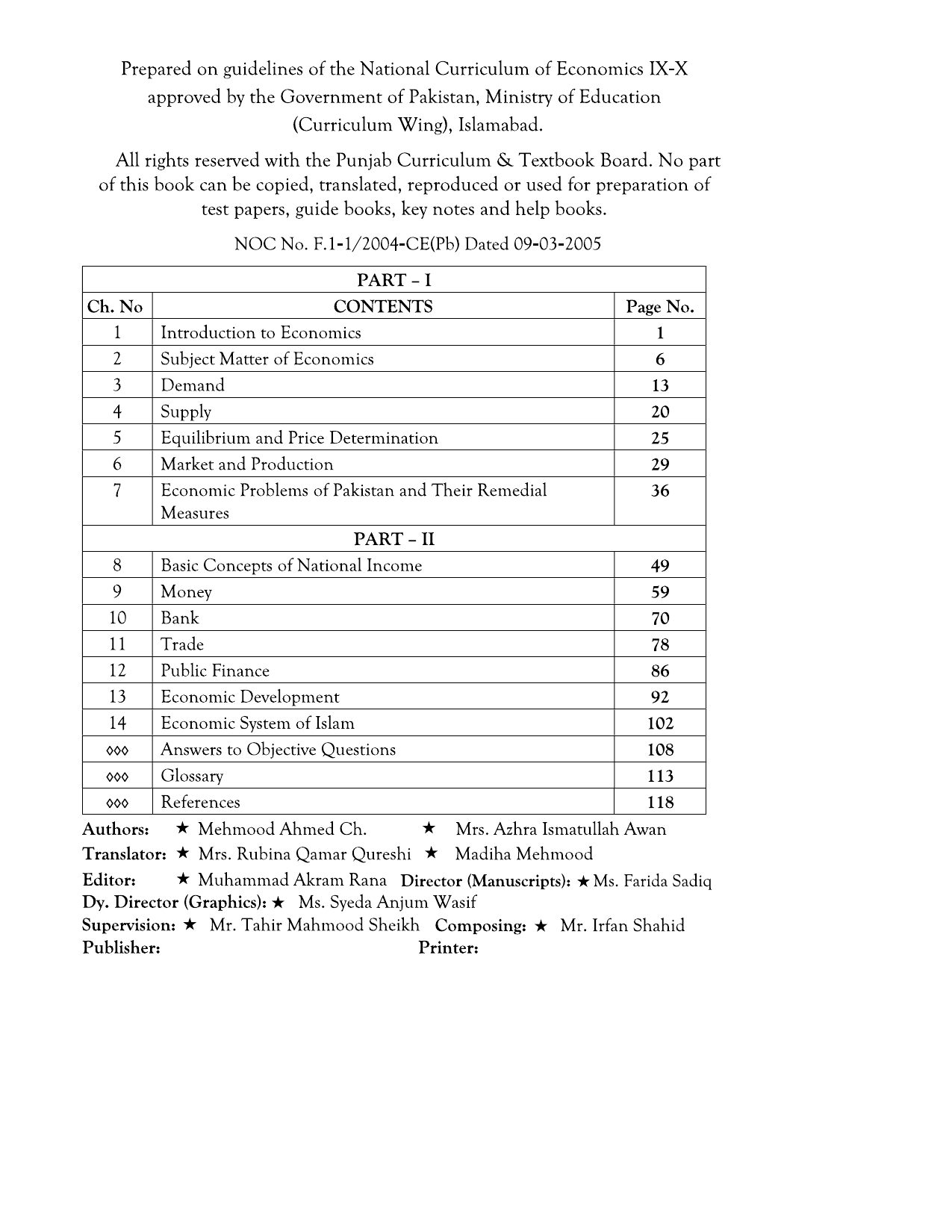
This is the English-medium Economics textbook for class 10, a direct translation of the Urdu edition in two parts. Part I lays the foundations: what economics is, demand, supply, equilibrium and price determination, market and production, and the economic problems of Pakistan with their remedial measures. Part II moves to the national economy: national income, money, banks, trade, public finance, economic development — closing with the economic system of Islam.
The book's strength is its Pakistan-centred treatment: chapter 7 analyses poverty, unemployment and population pressure with Economic Survey 2021-22 data, and chapter 14 sets out the Islamic economic system's principles of justice, fair earning and the prohibition of interest. Each chapter ends with a full exercise (MCQs, short and detailed questions) — the best exam preparation is to answer every question in writing.
Aham mozuaat
Chapter 1: Introduction to Economics
Page 1
Chapter 2: Subject Matter of Economics
Page 5
Chapter 3: Demand
Page 12
Chapter 4: Supply
Page 20
Chapter 5: Equilibrium and Price Determination
Page 25
Chapter 6: Market and Production
Page 29
Chapter 7: Economic Problems of Pakistan and Their Remedial Measures
Page 36
Chapter 8: Basic Concepts of National Income
Page 49
Chapter 9: Money
Page 59
Chapter 10: Banks
Page 70
Chapter 11: Trade
Page 78
Chapter 12: Public Finance
Page 86
Chapter 13: Economic Development
Page 92
Chapter 14: Economic System of Islam
Page 102
Ustad ka mashwara
Economics is for understanding, not memorising. Link every concept to your own life — when tomatoes are expensive in the bazaar, ask yourself: is this a demand problem or a supply problem? The student who makes their own examples is the one who can write in the exam. And prepare chapter 14 (Economic System of Islam) thoroughly — the long question comes from it.
— Rehman Ahmad Chaudhary, Head Teacher, GPS 117 DB(BJ), Yazman
Aksar pooche gaye sawalat
What is the definition of economics?
Economics comes from the Greek 'Oikonomikos', meaning household management. It is the study of human behaviour in satisfying unlimited wants with limited resources. It has two branches: microeconomics (individual units) and macroeconomics (the whole economy). Chapter 1, page 1.
How do demand, supply and equilibrium connect?
Demand is the quantity buyers will purchase at a given price (Chapter 3, page 12). Supply is the quantity sellers will sell at that price (Chapter 4, page 20). Where they are equal, the market is in equilibrium and the price is determined (Chapter 5, page 25) — the intersection of the demand and supply curves.
How does inflation arise according to this book?
Chapter 9 (Money, page 59) explains money and chapter 10 (Banks, page 70) the banking system. Inflation occurs when the money supply grows faster than goods — the book's example: Rs 100/10 items = Rs 10 each; Rs 200/10 items = Rs 20 each. More money chasing the same goods raises prices.
What are the basics of the Islamic economic system?
Chapter 14 (page 102) presents the Islamic economic system: a complete code based on the Quran and Sunnah, emphasising justice, brotherhood, fair earning, optimum use of natural resources, right of ownership with social responsibility, and the prohibition of interest — with Islamic banking modes like Musharika and Mudaraba.
Class 10 ki mazeed kitabein
Disclaimer
Ye kitab Punjab Curriculum and Textbook Board (PCTB) ki official publication hai. Download aur online reading PECTAA ki official e-books listing (pectaa.edu.pk) se faraham ki jati hai — sirf talimi maqsad ke liye. Malkiyat PCTB ki hai; is site ka koi dawa nahi.