· Rehman Ahmad · Worksheets · 7 min read
Personal Pronouns Chart for Kids (Free Printable)
Learn personal pronouns the fun way — I, we, you, they, he, she, it — with Motu Patlu charts, a story comic and a sing-along nazm. Free printable posters for class 1–5.
Every teacher knows this moment. A child writes:
“Ali is a good boy. Ali reads books. Ali plays football. Ali is my friend.”
Four times “Ali” in four lines. We smile, because we know exactly what is missing — a little word that does a big job: the pronoun.
But here is the problem. Pronouns are usually taught with dry tables and long definitions. Children memorise them for the test and forget them the next week. In my classroom, I tried something different: I taught pronouns with Motu Patlu — the cartoon characters every child already loves. The result? Children who point, laugh, shout the answers, and actually remember.
This post gives you everything I used: a personal pronouns chart, a full cases chart, a story comic strip, and a sing-along nazm — all free to print for your classroom.
What Is a Pronoun? (Simple Definition for Kids)
A pronoun is a word we use instead of a noun (the name of a person, place, animal or thing). We use pronouns so we don’t repeat the same name again and again.
Look at this:
- Without pronoun: “Ravi is my friend. Ravi is a teacher.” ❌
- With pronoun: “Ravi is my friend. He is a teacher.” ✅
“He” is the pronoun. It takes the place of “Ravi”. Simple, right? Now let’s meet all seven of them.
The 7 Personal Pronouns
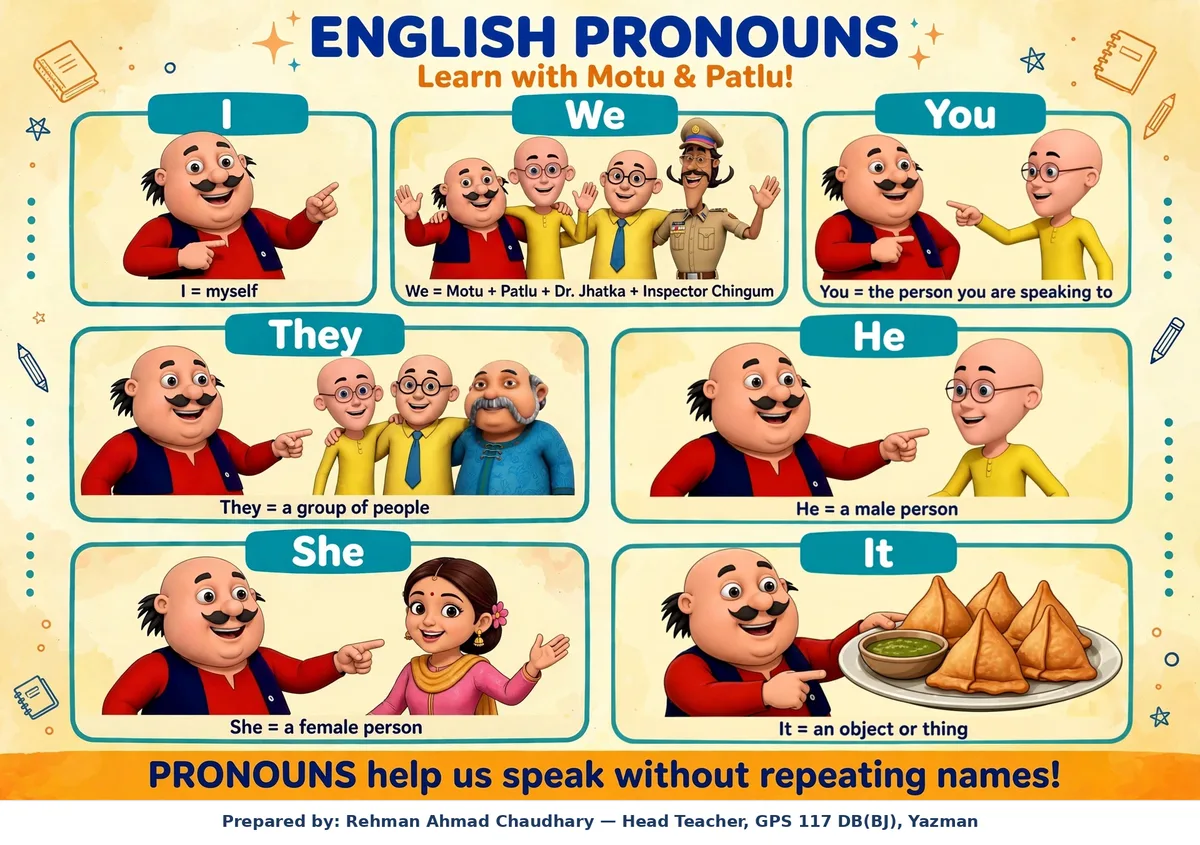
There are seven personal pronouns every child must know: I, We, You, They, He, She, It.
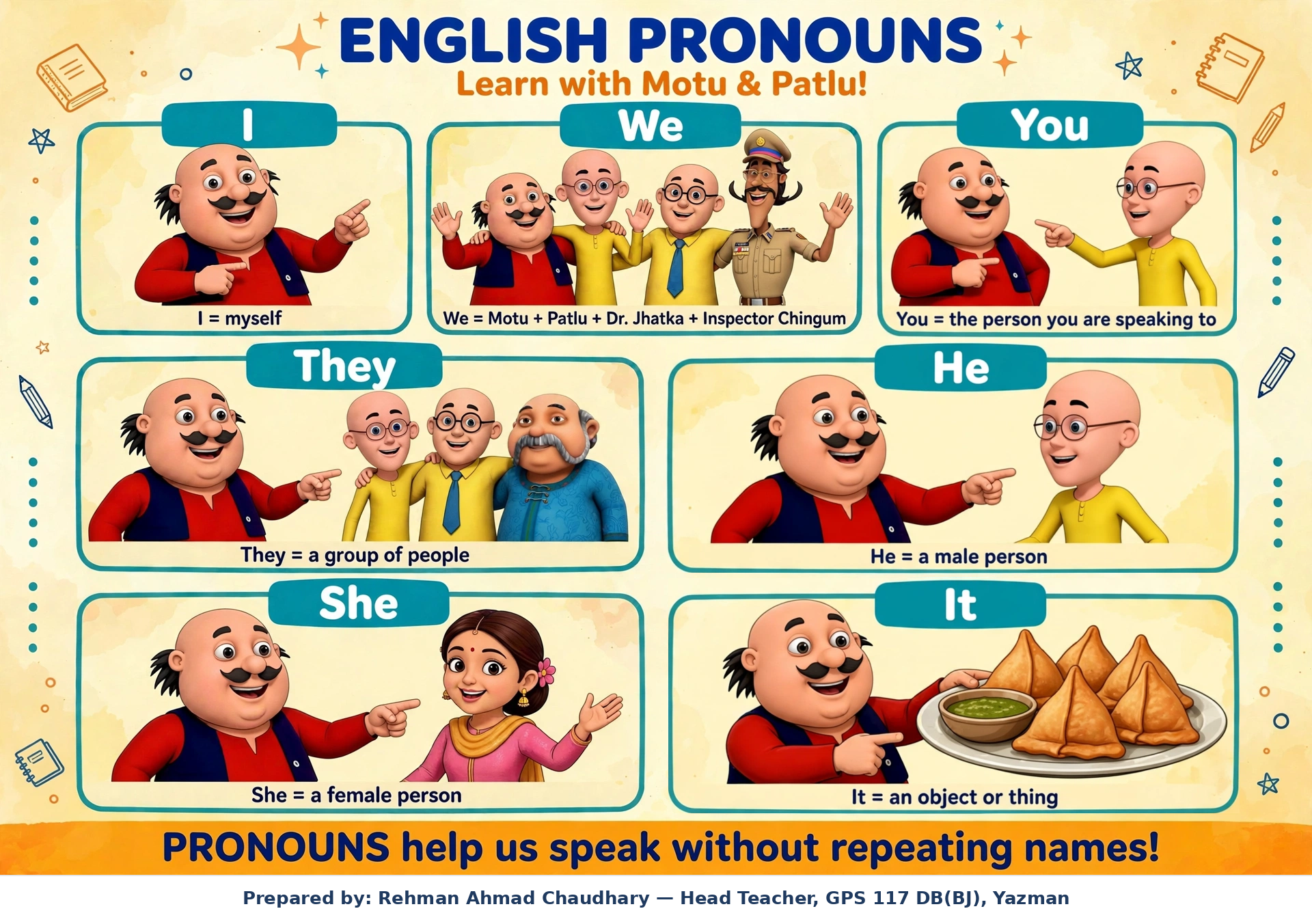
I made this poster for my classroom wall. Each pronoun has a character children can point at:
- I — Motu points at himself. One person speaking: “I am happy.”
- We — Motu, Patlu, Dr. Jhatka and Inspector Chingum together. The speaker + others: “We are friends.”
- You — Motu points at Patlu. The person you are talking to: “You are kind.”
- They — one person points at a group far away: “They are playing.”
- He — for one boy or man: “He is running.”
- She — for one girl or woman: “She is singing.”
- It — for one thing or animal: “It is a ball.”
Classroom trick: the biggest confusion is always We vs They. Teach it with a gesture — thumbs to your own chest for “We” (you are included!), both hands pointing far away for “They” (you are NOT included). Children never mix them up after this.
📥 Download the 7-pronouns poster (print quality)
All Cases in One Chart
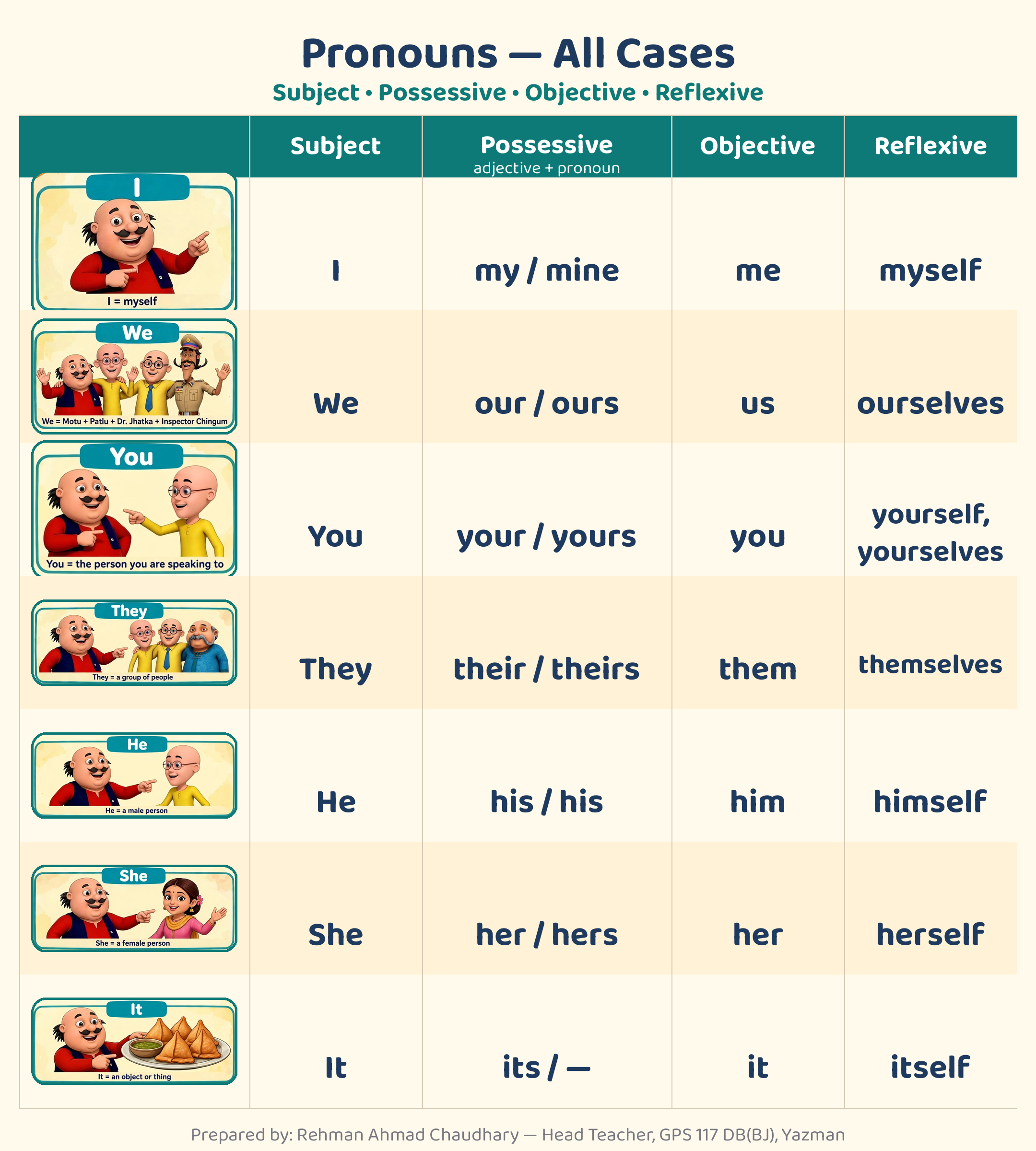
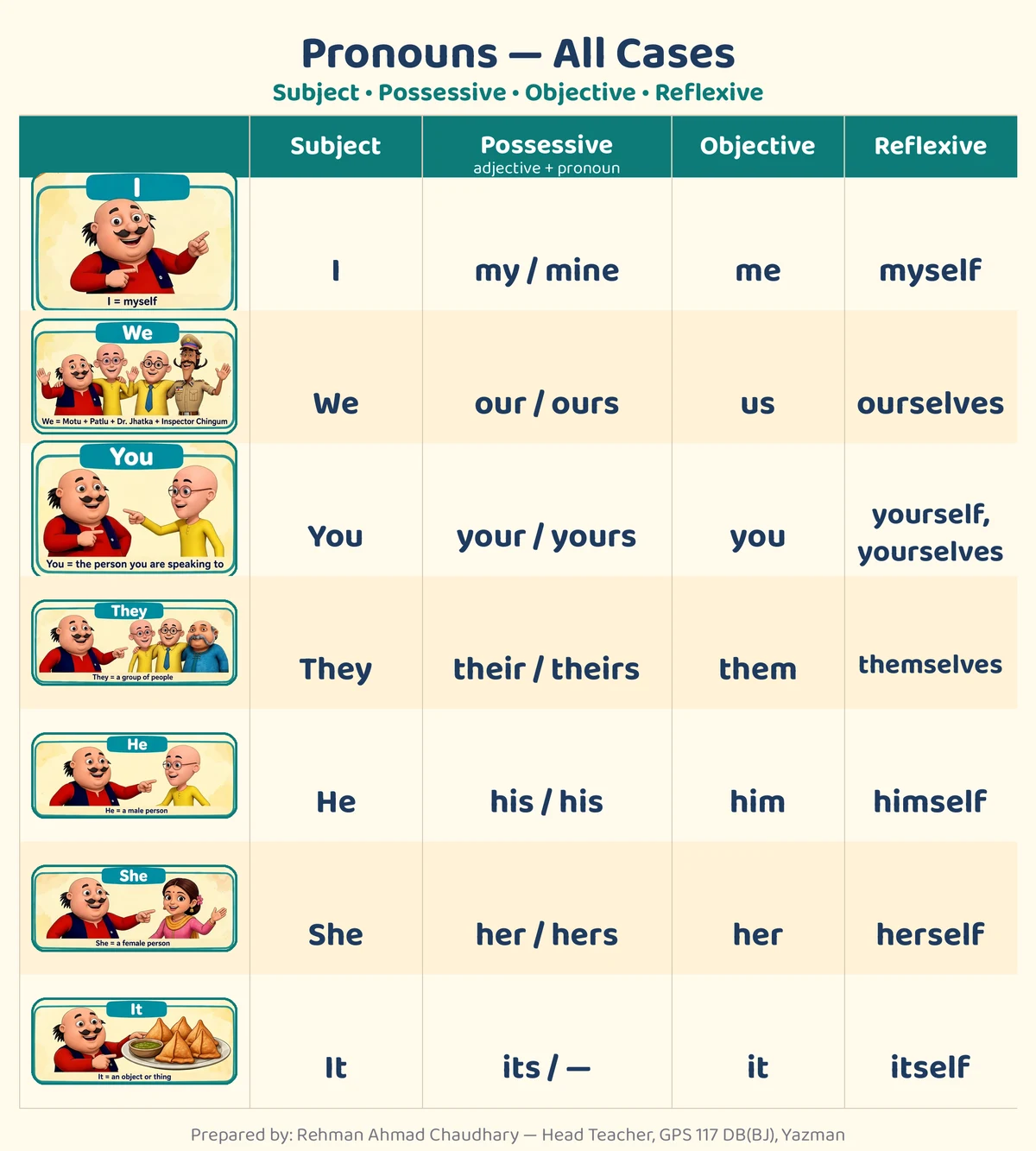
Here is where most charts stop — and where children get confused. Pronouns change their shape depending on their job in the sentence. “I” becomes “me”, “my”, “mine”, “myself”. These are called the cases of pronouns.
This one chart shows all the cases side by side — possessive adjectives and possessive pronouns share one column:
Let’s walk through each case with one-line examples.
1. Subjective pronouns (I, we, you, they, he, she, it)
These do the action. They come at the start of the sentence.
- I am reading. / They are playing.
2. Objective pronouns (me, us, you, them, him, her, it)
These receive the action. They come after the verb.
- The teacher helped me. / She invited us to the party.
The golden rule for kids: “I” starts the sentence, “me” never does. (“Ali and I went” ✅ — “Ali and me went” ❌)
3. Possessive adjectives (my, our, your, their, his, her, its)
These show ownership — and they always need a noun after them.
- My book, their house, her bag.
No noun after them? Then you need the next case…
4. Possessive pronouns (mine, ours, yours, theirs, his, hers)
These also show ownership — but they stand alone, with no noun after them.
- This book is mine (= my book). / The house is theirs (= their house).
My vs Mine — the one-line trick: “my” needs a friend (a noun) after it. “Mine” stands alone like a brave soldier. Children love this image and stop writing “mine book” forever.
5. Reflexive pronouns (myself, ourselves, yourself, himself, herself, itself, themselves)
These end in -self or -selves and point back to the subject — the action comes back like a boomerang.
- I taught myself. / She hurt herself.
📥 Download the all-cases chart (print quality)
Learn Pronouns Through a Story
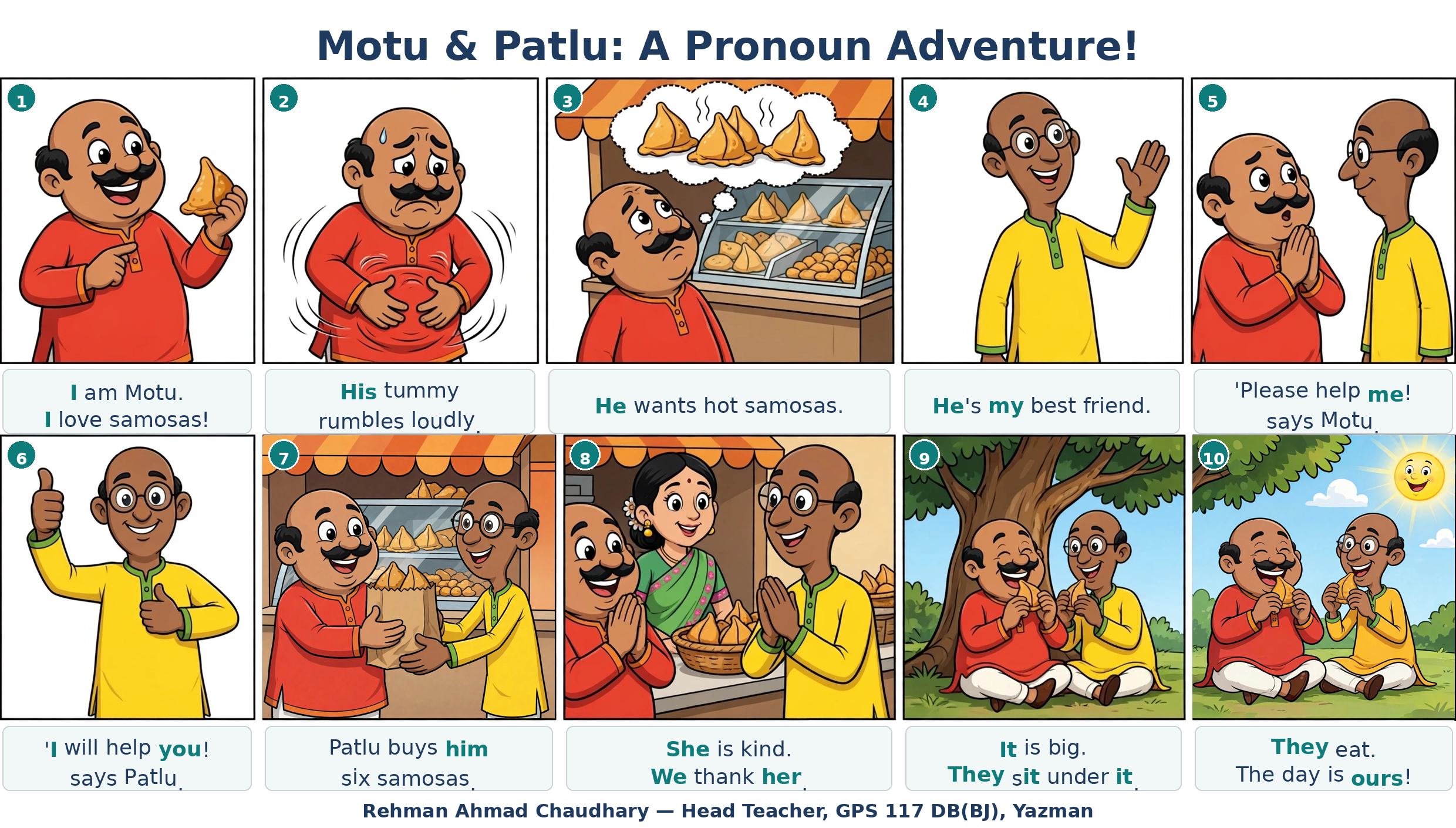
Rules are forgotten; stories are remembered. So I turned the pronouns into a 10-scene Motu Patlu adventure. Read it with the class and let children shout out every pronoun they spot — there are 14 hiding in the story!
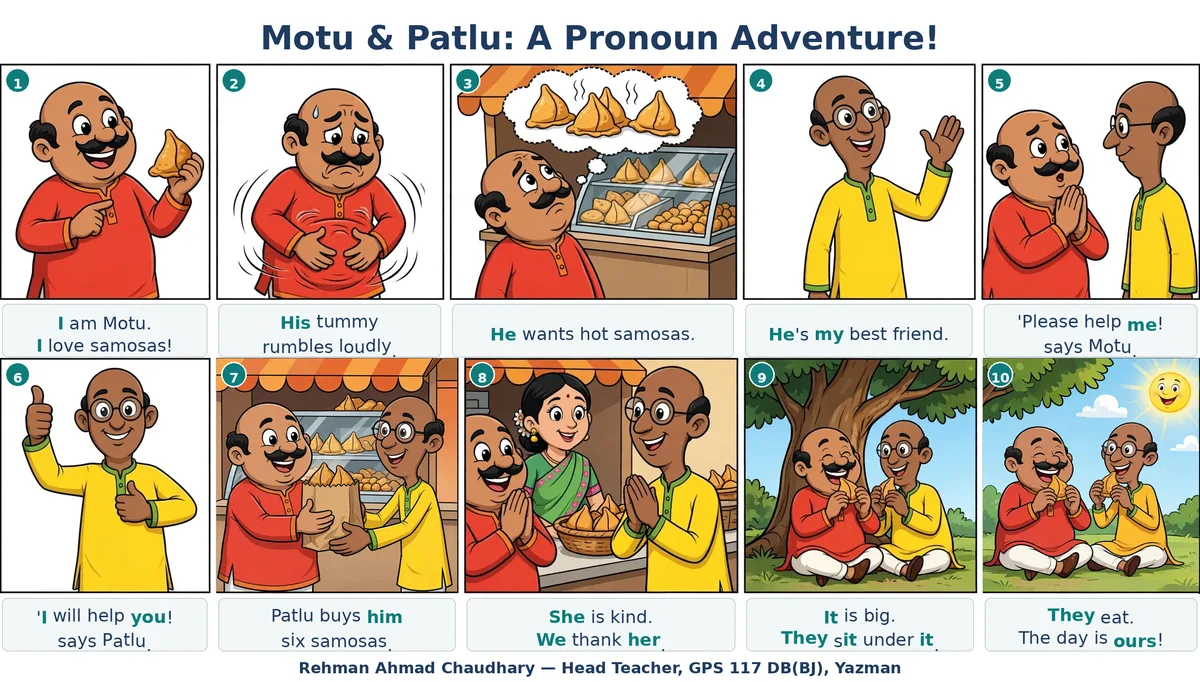
How to use it in class: read one panel aloud, pause, and ask “Which pronoun did you hear?” Children compete to find them first. By panel 10, even your shyest student will be shouting “themselves!”.
📥 Download the story comic (print quality)
Sing the Pronoun Nazm
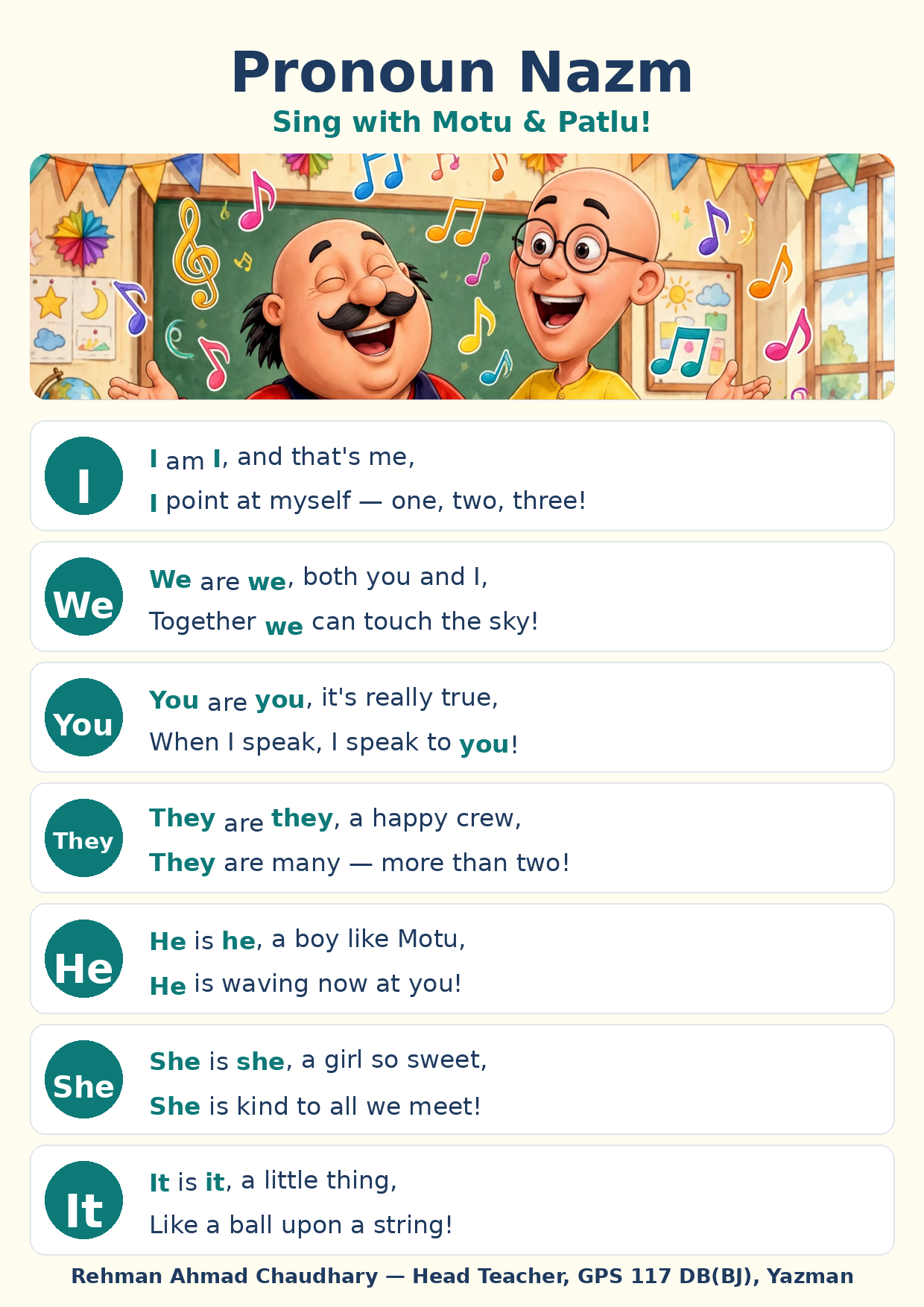
Ask any primary teacher: what is sung is remembered. This short nazm covers all seven pronouns — sing it together at the start of the English period for one week, and watch the magic.
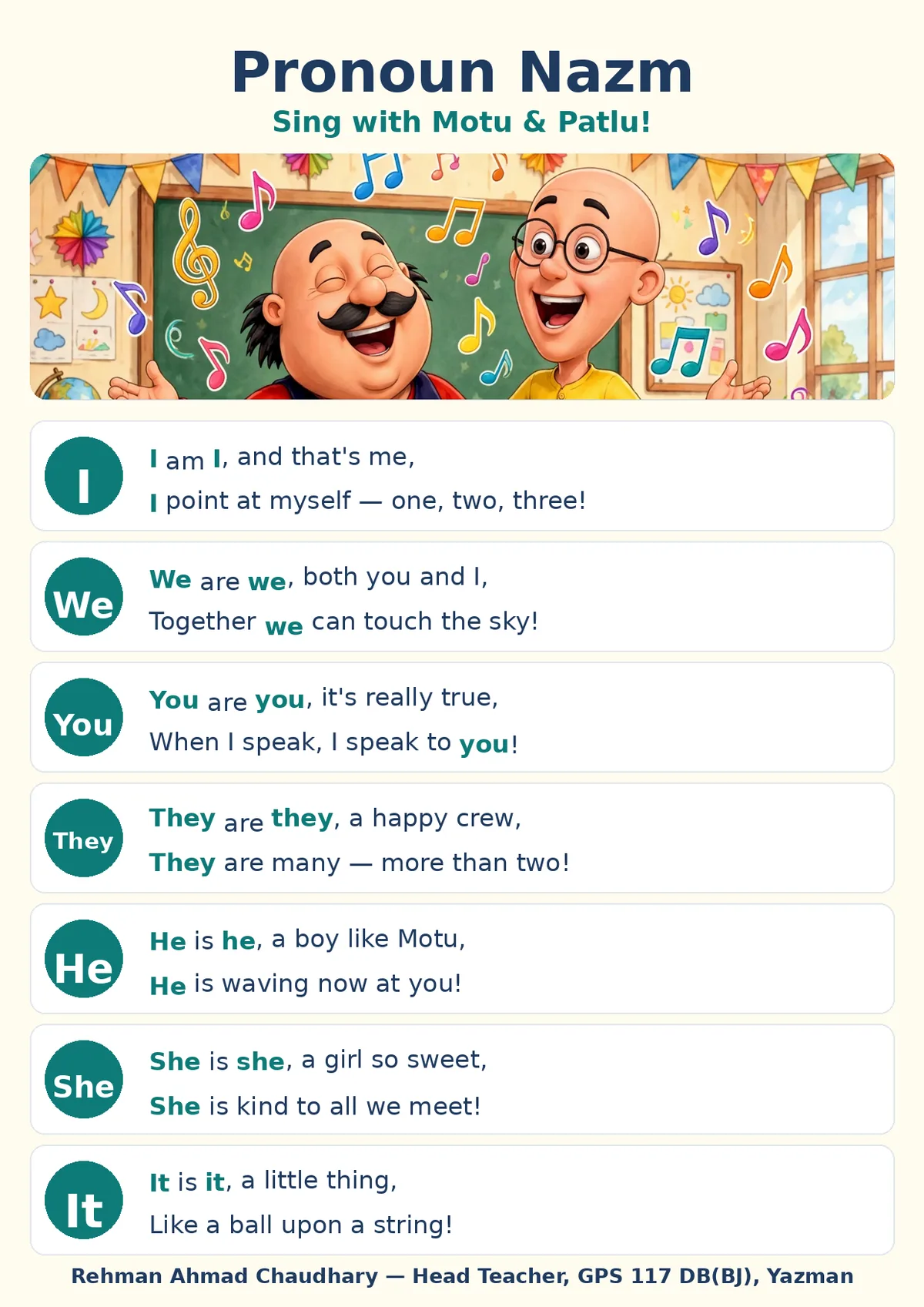
I am I, and that’s me, I point at myself — one, two, three! We are we, both you and I, Together we can touch the sky!
Seven verses, seven pronouns, zero boredom.
📥 Download the nazm poster (print quality)
3 Classroom Activities (5 Minutes Each)
1. The Pronoun Pointing Drill. Call out pronouns fast — children make the gesture: thumb to chest (I), point forward (You), gesture left/right (He/She), thumbs to chest with a neighbour (We), both hands far away (They). Speed it up. Laughter guaranteed.
2. The Great Noun Swap. Write “The bus is yellow.” on the board. A child erases “The bus” and writes “It”. Then “Sara and Ali are running” → “They”. Five minutes, full attention.
3. Whose Is It? Hold up a pencil. “It is mine.” Give it to a child: “Now it is yours.” The possessive pronouns learn themselves.
From My Classroom: B&W Prints, Crayons, and a Whiteboard
A word about resources. My school does not have a colour printer — so I printed all three charts in black and white on A4 paper, pasted the prints onto a chart board, and let the children colour them in with crayons. The big “PRONOUN” title is made of coloured clay letters. Then we hung the whole chart on the classroom whiteboard.
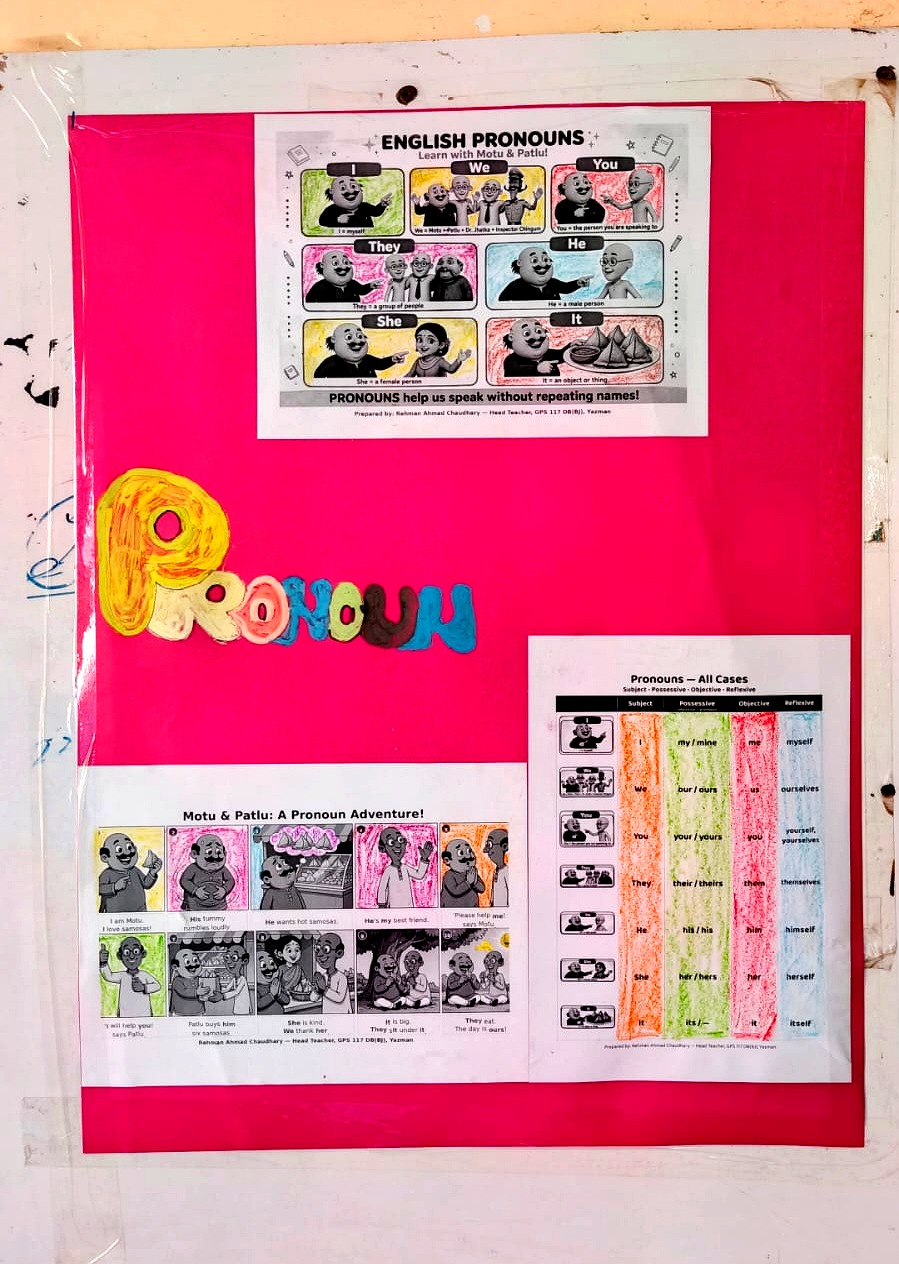
It is not a fancy printed poster — it is better. The children coloured it themselves, so every time they look at the whiteboard they see their own work teaching them pronouns. If you also have limited resources, try this: print in B&W, hand out the crayons, and let the class make the chart beautiful together.
Free Printable Charts — Download All
Everything in this post is free for classroom use:
- 7-Pronouns Poster (Motu Patlu) — for the classroom wall
- All-Cases Chart — subjective to reflexive
- Pronoun Story Comic — 10 scenes, 14 pronouns
- Pronoun Nazm Poster — sing-along verses
Print them on A4 or A3, laminate the wall poster, and keep the charts in children’s notebooks.
FAQs
What is the difference between “my” and “mine”? “My” is a possessive adjective — it must come before a noun (my book). “Mine” is a possessive pronoun — it stands alone (the book is mine). Remember: “my” needs a friend, “mine” stands alone.
When do we use “I” and when “me”? Use “I” when you do the action (Ali and I went). Use “me” when you receive the action (She helped me). “I” starts the sentence; “me” never does.
What is the difference between “we” and “they”? “We” includes the speaker (you + others). “They” does not include the speaker (only others, far away). Gesture trick: thumbs to your own chest = We; point far away = They.
What are reflexive pronouns? Pronouns ending in -self/-selves (myself, yourself, himself…) used when the subject and object are the same person — the action comes back to the doer: I taught myself.
How can I teach pronouns to kids in a fun way? Use characters they love, gestures for each pronoun, short stories packed with pronouns, and songs. The chart + comic + nazm in this post are built exactly for this method.
Prepared by Rehman Ahmad Chaudhary — Head Teacher, GPS 117 DB(BJ), Yazman. I make these charts for my own classroom first; if they work for my children, I share them here for yours.